

This article is about the “seed of David” argument that some people use to claim Joseph must have been the biological father of Jesus. The reasoning goes like this: since women don’t have seed (or sperm), and the prophecy says the Messiah would come from the seed of David, then Joseph had to be His father. But that’s not what the Bible teaches.
First, we’re going to see that the Bible itself speaks of women having seed. Second, we’ll see that the promise wasn’t about David’s literal sperm, but about his descendants. David had been dead for over 500 years before Christ was born—so the prophecy is pointing to the Messiah coming from David’s line, not directly from his body.
The Seed of David – What It Really Means
Some of the verses People Use
- Romans 1:3 – “Concerning his Son Jesus Christ our Lord, which was made of the seed of David according to the flesh.”
- 2 Timothy 2:8 – “Remember that Jesus Christ of the seed of David was raised from the dead according to my gospel.”
- Psalm 132:11 – “The LORD hath sworn in truth unto David; he will not turn from it; Of the fruit of thy body will I set upon thy throne.”
These verses are often used to argue that Jesus had to come directly from Joseph, since “seed” is mentioned. But that’s not what these scriptures mean.
When the Bible says “seed of David” it’s not saying David himself fathered Christ. It’s pointing to David’s descendants. If you take it literally, you’d be saying David was Christ’s direct father—which makes no sense because David had been dead for over 500 years before Jesus was born.
Women Do Have “Seed” in Scripture
The claim that women can’t have seed is actually contradicted by the Bible itself.
- Genesis 3:15 – “And I will put enmity between thee and the woman, and between thy seed and her seed; it shall bruise thy head, and thou shalt bruise his heel.”
Notice it says “her seed.” This isn’t about literal sperm. It’s about offspring—children that would come through the woman. And ultimately, this points to Christ, born of a woman, who would crush the serpent’s head.
Another Example: Seed of a Woman
- 1 Samuel 2:20 – “And Eli blessed Elkanah and his wife, and said, The LORD give thee seed of this woman for the loan which is lent to the LORD. And they went unto their own home.”
Here again we see the phrase “seed of this woman.” Clearly, “seed” is not just about sperm it’s about offspring or children. The blessing wasn’t about biology, but about God giving them descendants.
This proves the Bible itself uses “seed” to describe children coming through a woman, not just through a man.
David’s Seed = Offspring, Not Literal Sperm
When we read Act 13:22-23 (KJV
22 And when he had removed him, he raised up unto them David to be their king; to whom also he gave testimony, and said, I have found David the son of Jesse, a man after mine own heart, which shall fulfil all my will.
23 Of this man’s seed hath God according to his promise raised unto Israel a Saviour, Jesus:
It’s not saying the Messiah would come from David’s literal sperm. It’s saying Jesus is a descendant of David. How? Through Mary, who we’ll soon show is from David’s line.
Here’s the proof:
1) David’s Seed = His Offspring
2 Samuel 22:51
“He is the tower of salvation for his king: and sheweth mercy to his anointed, unto David, and to his seed for evermore.”
- “Seed” here clearly means David’s descendants – his family line, his offspring.
2) Christ from David’s Line
John 7:42
“Hath not the scripture said, That Christ cometh of the seed of David, and out of the town of Bethlehem, where David was?”
- Christ is called the “seed of David” because He is born from David’s lineage and from Bethlehem, David’s town.
3) Seed = Christ Himself
Galatians 3:16
“Now to Abraham and his seed were the promises made. He saith not, And to seeds, as of many; but as of one, And to thy seed, which is Christ.”
- Just like with Abraham, “seed” = offspring, and Paul makes it clear the promise is fulfilled in Christ.
Proof a Genealogy Can Be Traced Through the Mother
Now let’s look at an example where a genealogy is determined by a woman.
In 1 Chronicles 2, we’re given a genealogy specifically for the tribe of Judah. This is an Israelite record, meaning only Israelites should be listed here.
1) The Start of the Genealogy
1 Chronicles 2:1–3
“These are the sons of Israel; Reuben, Simeon, Levi, and Judah, Issachar, and Zebulun,
Dan, Joseph, and Benjamin, Naphtali, Gad, and Asher.
The sons of Judah; Er, and Onan, and Shelah: which three were born unto him of the daughter of Shua the Canaanitess. And Er, the firstborn of Judah, was evil in the sight of the LORD; and he slew him.”
This chapter is clearly a genealogy of Israel, and more specifically, the tribe of Judah.
The Key Detail
Now look further down:
1 Chronicles 2:34
“Now Sheshan had no sons, but daughters. And Sheshan had a servant, an Egyptian, whose name was Jarha.”
- Sheshan, an Israelite, had only daughters.
- Those daughters were still counted as Israelites.
The Marriage and Children
1 Chronicles 2:35
“And Sheshan gave his daughter to Jarha his servant to wife; and she bare him Attai.”
- One of Sheshan’s daughters marries Jarha, an Egyptian servant.
- Their son, Attai, is listed in the genealogy of Judah.
1Ch 2:36 (KJVA)
36 And Attai begat Nathan, and Nathan begat Zabad,
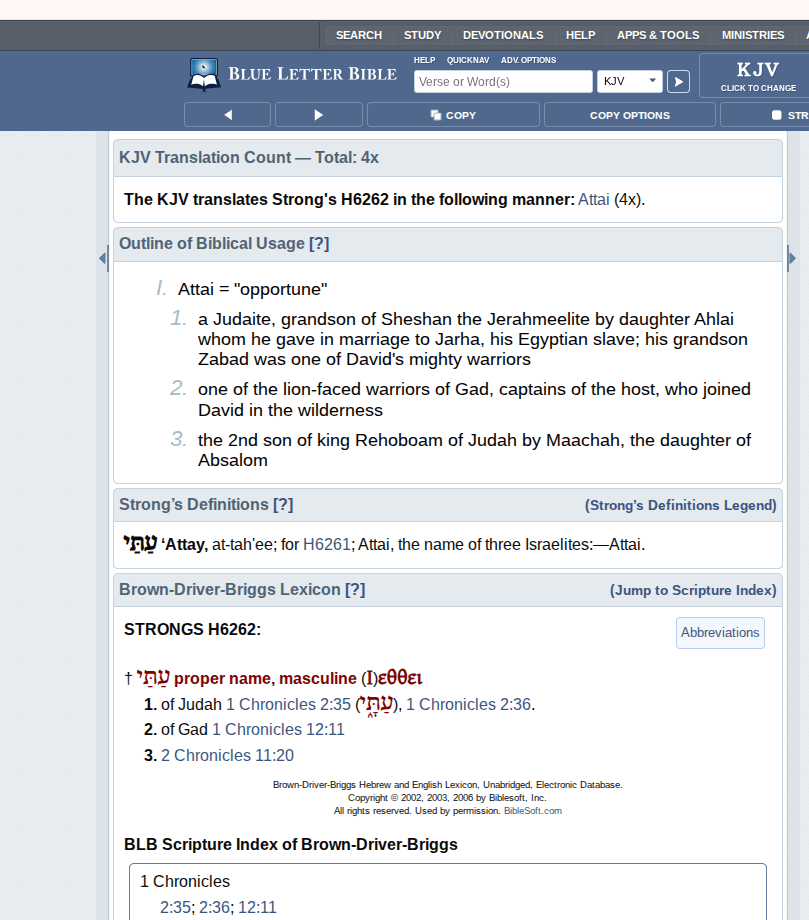
Further proof Attai was listed as an Israelite from the tribe of Judah.
https://www.blueletterbible.org/lexicon/h6262/kjv/wlc/0-1/
Why This Matters
If genealogies could only pass through men, then Attai (and his descendants) should have been considered Egyptians. They should not appear in Judah’s genealogy at all.
But the fact that they are included proves that a genealogy can pass through the mother’s line as well.
Second Evidence: Jair’s Case Judah or Manasseh?
Numbers 26:28–29 (KJV)
28 The sons of Joseph after their families were Manasseh and Ephraim.
29 Of the sons of Manasseh: of Machir the family of the Machirites: and Machir begat Gilead: of Gilead come the family of the Gileadites.
Here’s what’s happening:
- Joseph had two sons → Manasseh and Ephraim.
- Manasseh’s line is traced through his son Machir.
- Then Machir had Gilead, and the family line keeps going from there.
This genealogy is showing how the tribe of Manasseh kept growing through descendants. It’s locking down who belonged to that tribe and where their inheritance would go.
It’s setting the stage to later show how even when women got involved (like in the case of Jair in 1 Chronicles 2), the line still counted through them not just the men.
Now let’s get to 1 Chronicles 2 genealogy remember we already proved its a genealogy for Judah.
1 Chronicles 2:21–22 (KJV)
21 And afterward Hezron went in to the daughter of Machir the father of Gilead, whom he married when he was threescore years old; and she bare him Segub.
22 And Segub begat Jair, who had three and twenty cities in the land of Gilead.
Here’s the breakdown, real simple:
- Hezron (from the tribe of Judah) marries the daughter of Machir (who was from the tribe of Manasseh).
- Their son was Segub.
- Segub’s son was Jair.
- Jair ends up with 23 cities in Gilead (land tied to Manasseh).
See the point? Jair is biologically tied to Judah through Hezron… but because his grandmother was from Manasseh, his inheritance and identity are tied to Manasseh’s line.
Keep in mind was unlawfull for someone from one tribe to go to another tribe and have land inheritance.
Numbers 36:7
7 The inheritance of the people of Israel shall not be transferred from one tribe to another, for every one of the people of Israel shall hold on to the inheritance of the tribe of his fathers.
This means you can’t just hop tribes and claim land wherever you want. Judah can’t grab Manasseh land, and Manasseh can’t grab Judah’s.
So for Jair to inherit land in Manasseh, it proves he was counted through his mother’s side (Machir’s line from Manasseh). In other words, his tribal identity followed his mother here, not his father.
Jair’s story shows that your tribal identity could flow through your mother’s line. It wasn’t locked one way. Which side you were identified with — father or mother — determined your inheritance.
If this is is confusing at first please take the time to reread the point again carefully.
That means the genealogy is clearly counted through the woman here. If women’s lineage didn’t matter, Jair would never show up under Manasseh’s record.
Closing
We’re not going to break down Mary being from Judah in this article. That deserves its own full study. So if you’d like to see that, please click on the next article where we show undoubtedly that Mary is from the line of David (Judah).
The purpose of this article was simply to show two key things:
- Women do have seed according to Scripture.
- A genealogy can be traced through a woman.
This alone dismantles the false argument that the Messiah could only come through a man’s seed.


good stuff brother 👏🏿
LikeLike
thank you this is quite helpful.
LikeLike