
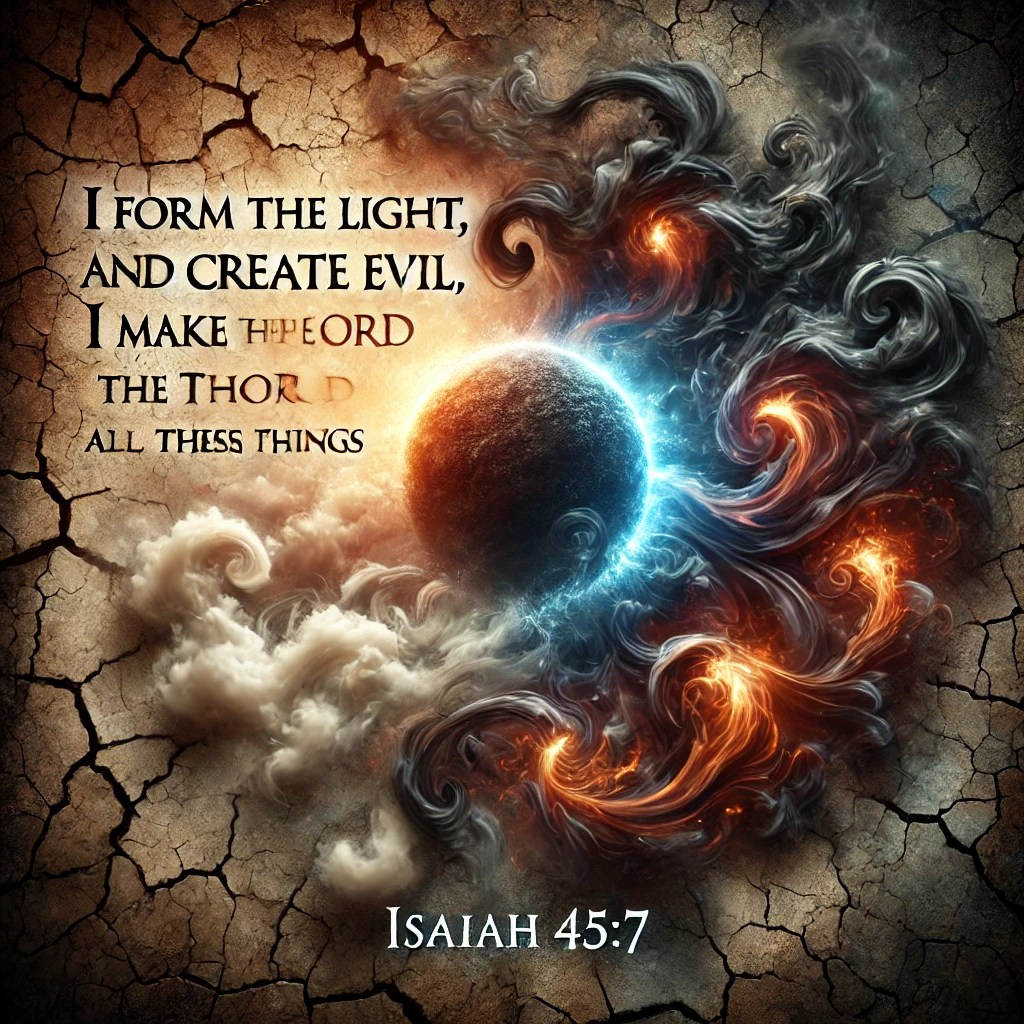
One common question people ask when they first encounter the idea of evil in Scripture is whether the Most High Himself is its true source. Many struggle with this, since it challenges what they’ve been taught and raises serious implications about the nature of God’s goodness.
A popular explanation of evil’s origin is the “fallen angels” doctrine—the idea that there was once a war in heaven, where Satan and his demons fought against Michael and the loyal angels. According to this view, Satan’s rebellion introduced evil into the world. However, we have already addressed and disproved that idea in a previous discussion.
Now, let’s turn to the Bible itself and see what it actually says about where evil comes from.
Isa 45:7 I form the light, and create darkness: I make peace, and create evil: I the LORD do all these things.
Many people stumble over these words because they assume more than what the verse actually says. The Most High clearly states that He creates evil, but He never claims to be evil Himself.
It’s a simple, yet common mistake: people read “create evil” and immediately think, “So God must be evil!” But the text does not say that. God is righteous, but He created evil for His own purpose.
Misunderstanding this can lead to unnecessary confusion. If the Most High truly created evil, we need to understand the reason behind it. How can a purely righteous God bring evil into existence?
To find the answer, we need to go back to where it all began—the Garden of Eden—so we can see how and why evil entered our world.
Gen 2:7 And the LORD God formed man of the dust of the ground, and breathed into his nostrils the breath of life; and man became a living soul.

Gen 3:9 And the LORD God called unto Adam, and said unto him, Where art thou?
The fact that the Most High created evil doesn’t mean that He is evil. Everything He made serves a purpose. In the beginning, when the Most High spoke to Adam, He placed responsibility on him as the man. Notice that He called out to Adam first, not Eve.
From Adam came a chosen lineage known as the “sons of God.” Throughout Scripture, we see this idea of certain groups being set apart for a special purpose—much like how Israel would later be chosen from among all nations.
If you’ve already read my earlier post, you’ll know that these “sons of God” in Genesis 6 are indeed humans, not angels. If you need a detailed breakdown on that topic, feel free to check out that previous article after you finish reading this one. Here is the link
Gen 6:1 And it came to pass, when men began to multiply on the face of the earth, and daughters were born unto them,
Gen 6:2 That the sons of God saw the daughters of men that they were fair; and they took them wives of all which they chose.
The key moment occurred when Adam and Eve chose to act outside of the Most High’s instructions. That decision let sin into the world, and from that point on, people’s hearts turned toward evil.
Gen 6:5 And GOD saw that the wickedness of man was great in the earth, and that every imagination of the thoughts of his heart was only evil continually.
Because of what happened in the Garden, humanity went astray. Violence and corruption spread so far that the Most High decided to cleanse the earth.
Gen 6:11 The earth also was corrupt before God, and the earth was filled with violence.
Gen 6:12 And God looked upon the earth, and, behold, it was corrupt; for all flesh had corrupted his way upon the earth.
Gen 6:13 And God said unto Noah, The end of all flesh is come before me; for the earth is filled with violence through them; and, behold, I will destroy them with the earth.
We see the link between the creation of evil and humanity’s choices. God created it with a purpose, but it was man’s disobedience that opened the door for it to spread.
From that point on, something fundamental changed. While we are not born guilty of sin the moment we enter the world, we arrive with an inclination to veer off course. In other words, we’re naturally drawn toward wrongdoing. This shift occurred after Adam and Eve’s disobedience, and now, as Scripture states, even children display a heart inclined toward evil from their youth.
Gen 8:21 And the LORD smelled a sweet savour; and the LORD said in his heart, I will not again curse the ground any more for man’s sake; for the imagination of man’s heart is evil from his youth; neither will I again smite any more every thing living, as I have done.
So evil, though it always had a place in the Most High’s plan, never found an outlet in human existence until Adam and Eve opened that door. Their actions paved the way for evil to manifest and influence our hearts from the very start.
Amo 3:6 Shall a trumpet be blown in the city, and the people not be afraid? shall there be evil in a city, and the LORD hath not done it?
This can be hard to accept because we’re used to blaming the devil for every bad event. However, the Scriptures clearly state that when “evil” takes place in a city, the Most High is the one behind it. In other words, what we call “evil” may actually be His righteous judgment, carried out for reasons we might not fully understand.
The Most High is in control, even over the harsh events we tend to label as evil. It’s not always the devil pulling the strings—often it’s the Most High’s own hand executing judgment, even if we don’t know all the details.

A powerful example of this can be seen in the story of Job. It was the Most High who initially brought Job to Satan’s attention, not the other way around. This shows us that even when it looks like evil forces are at work, everything still occurs under the Most High’s authority.
We see that the Most High may send evil spirits or bring severe judgments upon people. In real-time, those experiencing such calamities don’t always understand what’s happening. Yet behind the scenes, it’s often the angels of the Lord carrying out these judgments. For instance, pestilence is shown to be delivered by the hand of an angel.
1Ch 21:14 So the LORD sent pestilence upon Israel: and there fell of Israel seventy thousand men.
1Ch 21:15 And God sent an angel unto Jerusalem to destroy it: and as he was destroying, the LORD beheld, and he repented him of the evil, and said to the angel that destroyed, It is enough, stay now thine hand. And the angel of the LORD stood by the threshingfloor of Ornan the Jebusite.
This plague lasted from morning until the appointed time, resulting in massive loss of life.
2Sa 24:13 So Gad came to David, and told him, and said unto him, Shall seven years of famine come unto thee in thy land? or wilt thou flee three months before thine enemies, while they pursue thee? or that there be three days’ pestilence in thy land? now advise, and see what answer I shall return to him that sent me.
2Sa 24:14 And David said unto Gad, I am in a great strait: let us fall now into the hand of the LORD; for his mercies are great: and let me not fall into the hand of man.
2Sa 24:15 So the LORD sent a pestilence upon Israel from the morning even to the time appointed: and there died of the people from Dan even to Beersheba seventy thousand men.
In all these cases, what people might label as “evil” or attribute to Satan is actually part of the Most High’s judgment and authority. Nothing unfolds outside of His control.
Jdg 9:23 KJV 23 Then God sent an evil spirit between Abimelech and the men of Shechem; and the men of Shechem dealt treacherously with Abimelech:
The Most High always intended to use evil within His plan, but it remained hidden until Adam and Eve’s disobedience allowed it into our world.
As Scripture shows, the Most High sends evil spirits as a form of judgment, not because He Himself is evil. For example, He sent an evil spirit to stir up trouble between Abimelech and the men of Shechem:
We see this again with King Saul. After the Most High removed His spirit from Saul, He allowed an evil spirit to torment him. Notice that it was the Most High’s decision—Satan doesn’t have the authority to send spirits on his own.
1Sa 16:14 KJV 14 But the Spirit of the LORD departed from Saul, and an evil spirit from the LORD troubled him.
I’ve already covered in a previous post whether the Most High condones lying, so if you want more details on the situation in 1 Kings 22, feel free to revisit that after you’re done here. In this case, the “evil” we see is simply a form of judgment on a wicked individual. The Most High sent a lying spirit, not because He approves of lying, but as a consequence for someone who refused to walk in truth.
1Ki 22:19-23 KJV] 19 And he said, Hear thou therefore the word of the LORD: I saw the LORD sitting on his throne, and all the host of heaven standing by him on his right hand and on his left. 20 And the LORD said, Who shall persuade Ahab, that he may go up and fall at Ramothgilead? And one said on this manner, and another said on that manner. 21 And there came forth a spirit, and stood before the LORD, and said, I will persuade him.
22 And the LORD said unto him, Wherewith? And he said, I will go forth, and I will be a lying spirit in the mouth of all his prophets. And he said, Thou shalt persuade [him], and prevail also: go forth, and do so. 23 Now therefore, behold, the LORD hath put a lying spirit in the mouth of all these thy prophets, and the LORD hath spoken evil concerning thee.
Just as we see here, the Most High can send a strong delusion to those who choose to reject His truth and embrace wickedness.
2Th 2:11-12 KJV 11 And for this cause God shall send them strong delusion, that they should believe a lie: 12 That they all might be damned who believed not the truth, but had pleasure in unrighteousness.
In both instances, the Most High uses what we call “evil”—in the form of lying spirits or strong delusions—as a tool of judgment against those who have turned their backs on righteousness.
Rom 8:19-20 KJV 19 For the earnest expectation of the creature waiteth for the manifestation of the sons of God. 20 For the creature was made subject to vanity, not willingly, but by reason of him who hath subjected [the same] in hope,
Once sin entered the world, it became natural for us to lean toward wrongdoing. Even as believers, we struggle because our human nature—our flesh—is attracted to sin. We’re looking forward to the day when we’re freed from this imperfect body.

Rom 8:19 For the earnest expectation of the creature waiteth for the manifestation of the sons of God.
Rom 8:20 For the creature was made subject to vanity, not willingly, but by reason of him who hath subjected the same in hope,
The Most High is watching to see who will choose to seek Him. He isn’t forcing anyone; He wants to see who will turn to Him on their own. Unfortunately, most people turn away and don’t want to serve Him.
Psa 14:2 The LORD looked down from heaven upon the children of men, to see if there were any that did understand, and seek God.
Psa 14:3 They are all gone aside, they are all together become filthy: there is none that doeth good, no, not one.
This shows that our struggle with evil isn’t just about one moment in the Garden. It’s ongoing, and the Most High is watching to see who will choose to seek him.
In conclusion, evil didn’t begin through a cosmic rebellion of angels. Instead, Scripture shows that the Most High created evil with a purpose. It only surfaced in our world when Adam and Eve chose to step outside of His will, opening the door for sin to influence all of humanity. Since then, we’ve struggled against our own natures, drawn toward wrongdoing, yet called to seek the Most High
Evil operates under the Most High’s authority, ultimately serving His plans and purposes.

 The Bible Vault
edifying post brother 🙌🏾 APTTMHG keep it up
LikeLiked by 2 people