

As we step into faith, some believers misunderstand what real freedom in Christ looks like. While He has set us free, it doesn’t mean we’re without any standards. Instead, every law is now summed up through the commands of Christ.
Free Gracers believe that once you’re saved, you can do whatever you want—even commit terrible sins—and still be fine. But that’s not the freedom Scripture teaches. In Galatians 5:1 (KJV), Paul says: Stand fast therefore in the liberty wherewith Christ hath made us free, and be not entangled again with the yoke of bondage.
We’re called to stand in the freedom Christ gives us—not in the old restrictions of the Mosaic Law, but in the Father’s will. We’re no longer bound under the old system because if we do slip up, we can come to God, repent, and continue walking in the Spirit. True freedom isn’t a license to sin; it’s the power to live a life that honors God without fear of condemnation.
1Co 9:21 KJV
To them that are without law, as without law, (being not without law to God, but under the law to Christ,) that I might gain them that are without law.
Here, Paul clarifies that just because he’s no longer bound by the Mosaic Law, it doesn’t mean he’s lawless. Many of the same moral principles from the Old Testament appear in the New—yet we’re not under the Mosaic covenant. The priesthood has shifted from the Levites to Christ, our High Priest, and now we live under His law. Essentially, the “law of Christ” is about walking by the Spirit and following His teachings, not returning to old rituals or legalistic rules.
John 14:15 KJV
If ye love me, keep my commandments.
Some get confused and assume Christ is talking about the Mosaic Law when He says, “keep my commandments.” However, as our High Priest, He’s leading us into His own dispensation. Certain commands were originally given to Israel to set them apart from other nations—like avoiding pork—but those rules weren’t meant for everyone. They weren’t inherently “bad,” but rather served as unique markers for God’s chosen people at that time. Now, we follow the commandments of Christ, guided by the new covenant He established, which calls all believers—Jews and Gentiles alike—to a higher spiritual walk, centered on His teachings and love.
How do you keep the laws of Christ minus the laws of Moses?
1 Thessalonians 4:1-2 KJV
Furthermore then we beseech you, brethren, and exhort you by the Lord Jesus, that as ye have received of us how ye ought to walk and to please God, so ye would abound more and more. For ye know what commandments we gave you by the Lord Jesus.
Here, Paul reminds believers to keep growing in the way they live for God—not according to the Mosaic Law, but through the instructions Christ gave His apostles. This reflects the idea of progressive revelation: as Scripture unfolds from Old to New Testament, we gain a clearer understanding of God’s will. For believers in the New Testament era, the commandments of Christ serve as our guide. Whatever Christ taught—and the apostles passed on—becomes the “matrix” for how we live and please God.
1 Thessalonians 4:3-5 KJV
For this is the will of God, even your sanctification, that ye should abstain from fornication: That every one of you should know how to possess his vessel in sanctification and honour; Not in the lust of concupiscence, even as the Gentiles which know not God.
God’s will for us is sanctification—the process of being set apart for Him until the end. This includes avoiding both physical and spiritual fornication. In other words, we steer clear of any rebellion against what we’re called to do. We also need to “possess our vessel” with honor, meaning we must use self-control over our bodies and desires. The term “concupiscence” refers to intense lust, and without the Holy Spirit, it’s easy to be pulled into destructive thoughts and actions. But as believers, we’re empowered to live differently—honoring God by walking in holiness, not giving in to the impulses that once controlled us.
1 Thessalonians 4:6-8 KJV
That no man go beyond and defraud his brother in any matter: because that the Lord is the avenger of all such, as we also have forewarned you and testified. For God hath not called us unto uncleanness, but unto holiness. He therefore that despiseth, despiseth not man, but God, who hath also given unto us his holy Spirit.
Paul warns that giving in to lust can push us to hurt others—like being unfaithful with a friend’s partner. If we don’t learn self-control, we’ll end up doing things we’ll regret. God calls us to be a holy people, set apart from the world’s ways. When some people hear this, they may reject it, but they’re really rejecting the One who gave us His Holy Spirit. It’s not just about rules or opinions; it’s about aligning with God’s standard of purity and love.
Colossians 3:1-2 KJV
If ye then be risen with Christ, seek those things which are above, where Christ sitteth on the right hand of God. Set your affection on things above, not on things on the earth.
Paul is teaching us that if we’re truly united with Christ, we need to focus on heavenly things—not just earthly concerns. By “removing” earthly distractions, we can draw closer to the Most High.
Colossians 3:3 KJV
For ye are dead, and your life is hid with Christ in God.
If you’re serious about living a spiritual life, you can’t keep one foot in the world and one foot in the kingdom. When we lean into the Spirit, God helps lift our burdens and strengthens us where we’re weak. We keep our focus on Him because we’re looking forward to sharing in His glory—this hope shapes how we live here and now.
Colossians 3:4-7 KJV
When Christ, who is our life, shall appear, then shall ye also appear with him in glory. Mortify therefore your members which are upon the earth; fornication, uncleanness, inordinate affection, evil concupiscence, and covetousness, which is idolatry: For which things’ sake the wrath of God cometh on the children of disobedience: In the which ye also walked some time, when ye lived in them.
Paul points out that if we want to share in Christ’s glory when He returns, we need to “mortify”—or put to death—earthly desires like fornication, uncleanness, and inordinate affection (improper or excessive passions). These behaviors once defined us, but as new creations in Christ, we can’t stay stuck in that old lifestyle. If we’re serious about living in the Spirit, we have to let go of those harmful habits that separate us from God.
Colossians 3:8-10 KJV
But now ye also put off all these; anger, wrath, malice, blasphemy, filthy communication out of your mouth. Lie not one to another, seeing that ye have put off the old man with his deeds; And have put on the new man, which is renewed in knowledge after the image of him that created him.
Paul tells us to set aside destructive attitudes like anger, malice, and foul language. We’re also called to be truthful with one another, because we’ve shed our old selves and taken on a “new man.” This new identity is energized by God’s Spirit, empowering us to speak honestly and respectfully. As we let the Spirit transform us, our words and attitudes begin to reflect the One who created us.
1 Corinthians 6:9-11 KJV
Know ye not that the unrighteous shall not inherit the kingdom of God? Be not deceived: neither fornicators, nor idolaters, nor adulterers, nor effeminate, nor abusers of themselves with mankind, Nor thieves, nor covetous, nor drunkards, nor revilers, nor extortioners, shall inherit the kingdom of God. And such were some of you: but ye are washed, but ye are sanctified, but ye are justified in the name of the Lord Jesus, and by the Spirit of our God.
Paul makes it clear that a lawless lifestyle—one consumed by sin—has no place in God’s kingdom. A reviler is someone who stirs up trouble or abuses others, and that kind of behavior, like the rest listed here, shuts us off from true fellowship with God. Yet Paul also reminds believers that many of us used to live this way. By God’s mercy, we’ve been cleansed and made holy through Christ. Even if we stumble, we can repent and continue in His grace, living as people who have genuinely turned from our old ways.
1 Corinthians 6:15-18 KJV
Know ye not that your bodies are the members of Christ? shall I then take the members of Christ, and make them the members of an harlot? God forbid. What? know ye not that he which is joined to an harlot is one body? for two, saith he, shall be one flesh. But he that is joined unto the Lord is one spirit. Flee fornication. Every sin that a man doeth is without the body; but he that committeth fornication sinneth against his own body.
Paul highlights that, as believers, our bodies are united with Christ. Some people wrongly claim that visiting a prostitute if you’re unmarried is acceptable, but Scripture rejects that idea. Engaging in sexual sin makes you “one flesh” with the other person, dragging Christ’s body into wrongdoing. Unlike other sins, fornication strikes at your own body—the very place where the Holy Spirit dwells—so we’re urged to flee from it.
How do we know we have the Holy Spirit?
- Ephesians 1:13-14 KJV
In whom ye also trusted, after that ye heard the word of truth, the gospel of your salvation: in whom also after that ye believed, ye were sealed with that holy Spirit of promise, [14] Which is the earnest of our inheritance until the redemption of the purchased possession, unto the praise of his glory.
- The holy spirit guides us on our path until we are made right.
- The holy spirit is keeping us aligned so we don’t fall until YHWSHI comes and gives us the correct understanding.
- The Holy Spirit preserves you through your walk Until Yahawashi comes back
- The holy spirit comfort us through our difficult times, it is a comforter. We learn this through studying the word.
1 Corinthians 6:19-20 KJV
What? know ye not that your body is the temple of the Holy Ghost which is in you, which ye have of God, and ye are not your own? For ye are bought with a price: therefore glorify God in your body, and in your spirit, which are God’s.
Paul reminds us that as believers, we’re not our own. Our bodies are temples where the Holy Spirit lives, and Christ has paid for us with His life. That means both our physical selves and our spiritual selves belong to God. Because of this, we’re called to honor Him in every way—mind, body, and soul—reflecting the fact that we’re His people, set apart for His purposes.


Galatians 5:19-21 KJV
Now the works of the flesh are manifest, which are these; Adultery, fornication, uncleanness, lasciviousness, Idolatry, witchcraft, hatred, variance, emulations, wrath, strife, seditions, heresies, Envyings, murders, drunkenness, revellings, and such like: of the which I tell you before, as I have also told you in time past, that they which do such things shall not inherit the kingdom of God.
Paul lists the actions and attitudes that flow from our fallen human nature, warning that anyone who lives in these sins without repentance will miss out on God’s kingdom. This doesn’t mean believers never stumble, but we don’t make these behaviors our lifestyle. Through the Holy Spirit, we have the power to leave these works of the flesh behind and walk in the freedom and holiness God desires for us.
Definitions: The Greek words are also included
- Adultery (moicheia)
- Having sexual intercourse with someone who isn’t your spouse while you’re married.
- Example: A married person cheating on their spouse.
- Fornication (porneia)
- Any sexual relationship outside of marriage, including other forms of sexual immorality.
- Example: An unmarried couple living together and being sexually active.
- Uncleanness (akatharsia)
- Engaging in morally impure actions or harboring impure desires that go against God’s standards.
- Example: Persistently thinking or fantasizing about sinful acts.
- Lasciviousness (aselgeia)
- Uncontrolled or shameless lust, often displayed in indecent or lewd behavior.
- Example: Making obscene gestures or indulging in explicit, suggestive dancing.
- Idolatry (eidololatria)
- Placing anything—an object, person, or concept—in the position of worship that belongs to God alone.
- Example: Prioritizing money/ your job / your goals or success over your relationship with God.
- Witchcraft (pharmakeia)
- Seeking spiritual power or guidance through magic/card reading spells, or the occult, rather than through God.
- Example: Consulting psychics or using spells to manipulate events.
- Hatred (echthra)
- Deep hostility or ill will toward another person.
- Example: Constantly wishing harm on someone because of a past grievance.
- Variance (eris)
- Ongoing quarrels, arguments, or disputes that stir up division.
- Example: Picking fights over trivial issues, causing stress in a community or group.
- Emulations (zelos)
- Jealousy or rivalry, fueled by a desire to outdo or surpass someone else.
- Example: Feeling bitter every time someone else gets a promotion or recognition.
- Wrath (thymos)
- Intense anger that can lead to violence or harmful actions.
- Example: Lashing out in rage and destroying property during an argument.
- Strife (eris)
- Selfish conflict or competition that tears relationships apart.
- Example: Constant bickering in a family over personal preferences or power struggles.
- Seditions (dichostasiai)
- Encouraging rebellion or causing divisions within a group.
- Example: Stirring up people against their leaders to split a church or community.
- Heresies (hairesis)
- Following or spreading beliefs that go against core biblical truth and cause spiritual confusion.
- Example: Teaching that Jesus isn’t the Son of God within a Christian church.
- Envyings (phthonoi)
- Resenting what others have, whether it’s possessions, success, or relationships.
- Example: Being upset when a friend achieves something great instead of being happy for them.
- Murders (phonoi)
- Taking someone’s life—or “killing” them spiritually through severe hatred or slander.
- Example: Actual homicide or tearing down someone’s reputation with malice.
- Drunkenness (methai)
- Excessive drinking or substance abuse that impairs judgment and leads to reckless behavior.
- Example: Regularly getting so intoxicated that it harms health, relationships, or safety.
- Revellings (komoi)
- Wild partying or outrageous conduct, often tied to heavy drinking and lack of restraint.
- Example: Attending parties where the main focus is getting drunk and behaving irresponsibly.
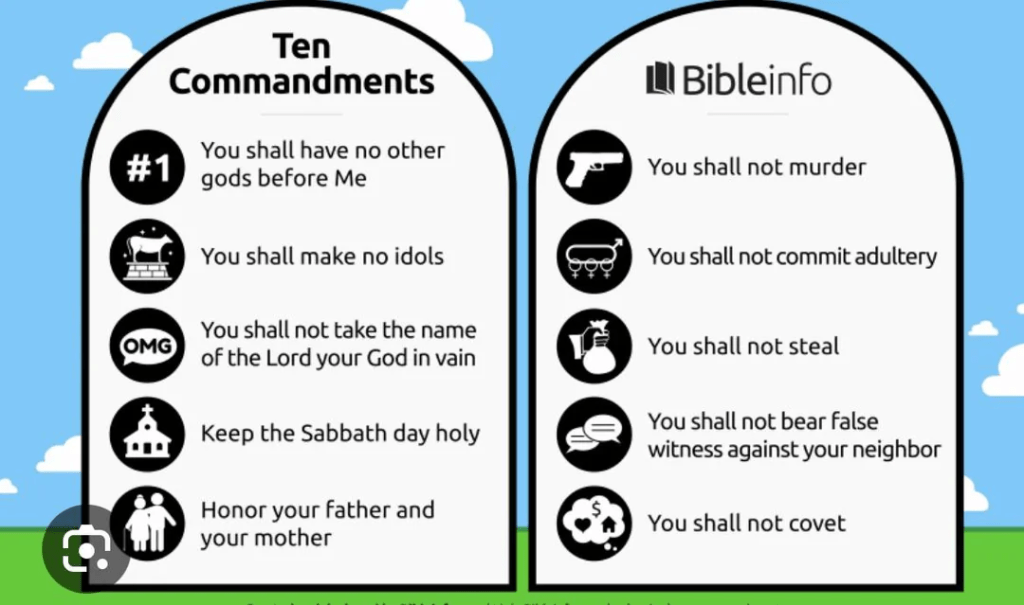
(The Ten Commandments in the New Testament)
- One God
1 Corinthians 8:6 KJV –
But to us there is but one God, the Father, of whom are all things, and we in him; and one Lord Jesus Christ, by whom are all things, and we by him. - No Idols
1 John 5:21 KJV –
Little children, keep yourselves from idols. Amen. - Do Not Blaspheme
1 Timothy 6:1 KJV –
Let as many servants as are under the yoke count their own masters worthy of all honour, that the name of God and his doctrine be not blasphemed. - Sabbath Rest
Of all the Ten Commandments, “Remember the Sabbath and keep it holy” is the only one not directly repeated in the New Testament. Hebrews 4:9–11 points toward a spiritual rest in Christ—He has freed us, and our ultimate rest is in Him. Matthew 22:40 teaches that if we truly love God and our neighbor, we fulfill the entire law (including the spirit behind the Sabbath), but we aren’t bound to the physical requirements of the Mosaic Sabbath. - Honor Your Parents
Ephesians 6:1–2 KJV –
Children, obey your parents in the Lord: for this is right. Honour thy father and mother; (which is the first commandment with promise.) - 6. You Shall Not Murder
- 1 John 3:15 – “Whosoever hateth his brother is a murderer: and ye know that no murderer hath eternal life abiding in him.”
- 1 Peter 4:15 – “But let none of you suffer as a murderer…”
- 7. You Shall Not Commit Adultery
- 1 Corinthians 6:9–10 – “…neither fornicators, nor idolaters, nor adulterers…shall inherit the kingdom of God.”
- 8. You Shall Not Steal
- Ephesians 4:28 – “Let him that stole steal no more…”
- 9. You Shall Not Bear False Witness
- Colossians 3:9 – “Lie not one to another, seeing that ye have put off the old man with his deeds.”
- 10. You Shall Not Covet
- Ephesians 5:5 – “For this ye know, that no whoremonger…nor covetous man, who is an idolater, hath any inheritance in the kingdom of Christ and of God.”
Revelation 14:12 KJV
Here is the patience of the saints: here are they that keep the commandments of God, and the faith of Jesus.
This is referring to the commandments of Christ
We keep the commandments by faith in christ
We don’t keep the faith by keeping the laws of Moses.
1 Timothy 4:12-16 KJV
Let no man despise thy youth; but be thou an example of the believers, in word, in conversation, in charity, in spirit, in faith, in purity. Till I come, give attendance to reading, to exhortation, to doctrine. Neglect not the gift that is in thee, which was given thee by prophecy, with the laying on of the hands of the presbytery. Meditate upon these things; give thyself wholly to them; that thy profiting may appear to all. Take heed unto thyself, and unto the doctrine; continue in them: for in doing this thou shalt both save thyself, and them that hear thee.
Paul is basically telling Timothy: “Don’t let anyone look down on you just because you’re young. Instead, show people what genuine faith looks like—through your words, how you live, how you love, and how you stay pure. Keep reading the Scriptures, encourage others with the truth, and don’t ignore the gifts God gave you. Put your whole heart into growing in these things, so everyone can see how far you’ve come. Watch your life and teaching closely, and stick to them. That way, you’ll help both yourself and anyone who listens to you find salvation.”
In simpler terms, Timothy needed to be ‘all in.’ He shouldn’t treat his calling or the Scriptures as just another task. Paul encouraged him (and us) to make these truths part of everyday life, letting them shape who we are. When we do that, we inspire others to walk in faith, too—and that’s a big part of what it means to live out the gospel.

We are not lawless, we do have expectations on how to live. We have to make sure that we are examining ourselves and living up to a standard and being a light to those in our path.


“This was beautiful, my king. So inspiring and full of truth. It edified my spirit and lifted me in ways I truly needed. May the Holy Spirit continue to lead you into all truth. Thawadah.”
LikeLiked by 2 people
Very edifying 💕
LikeLiked by 1 person
All praises 🙌🏾 I’m very glad to hear that.
LikeLike