

Plenty of believers have heard the claim that two Old-Testament heroes—Enoch and Elijah—somehow skipped death and went straight to glory. The idea is so popular that many Christians plug the pair right back in at the end of the Bible, insisting they must be the mysterious “two witnesses” of Revelation 11. “After all,” the argument goes, “they never died, so they have to come back and die once.”
But is that really what Scripture teaches once we gather all the evidence—including the New-Testament passages that insist Jesus alone conquered the grave? In this article we’ll:
- Re-examine the original stories of Enoch (Genesis 5) and Elijah (2 Kings 2).
- Compare those accounts with what Jesus and the apostles say about death and resurrection.
Why write about it? Because if we misread these well-known accounts, we risk missing the bigger point of the Bible—that only Christ has defeated death for everyone who trusts Him. Clearing up the confusion about Enoch and Elijah not only sets the record straight; it also puts the spotlight back where it belongs: on the One who actually holds the keys of death and Hades.
Secrets in the Bible

Here’s something cool about the Bible: it loves to tuck big truths inside small phrases. Take Genesis 5:24. Most of us read, “Enoch walked with God, and he was not, for God took him,” and jump to, “Ah—he never died.” But the verse is actually hinting at the opposite. The line “he was not” simply means he was gone—dead—only God personally handled his departure. It’s one of those quiet details you miss unless you slow down.
Psalms 25:14 (KJV)
14 The secret of the LORD is with them that fear him; and he will shew them his covenant.
In other words, God slips deeper secrets to people who keep digging. Enoch’s story is one of those hidden-in-plain-sight moments. Dive beneath the surface, and you’ll see the Bible hasn’t given anyone a free pass on death—only a glimpse of how closely God walks with those who trust Him.
First Things First: Why the New Testament Says Everybody Dies.
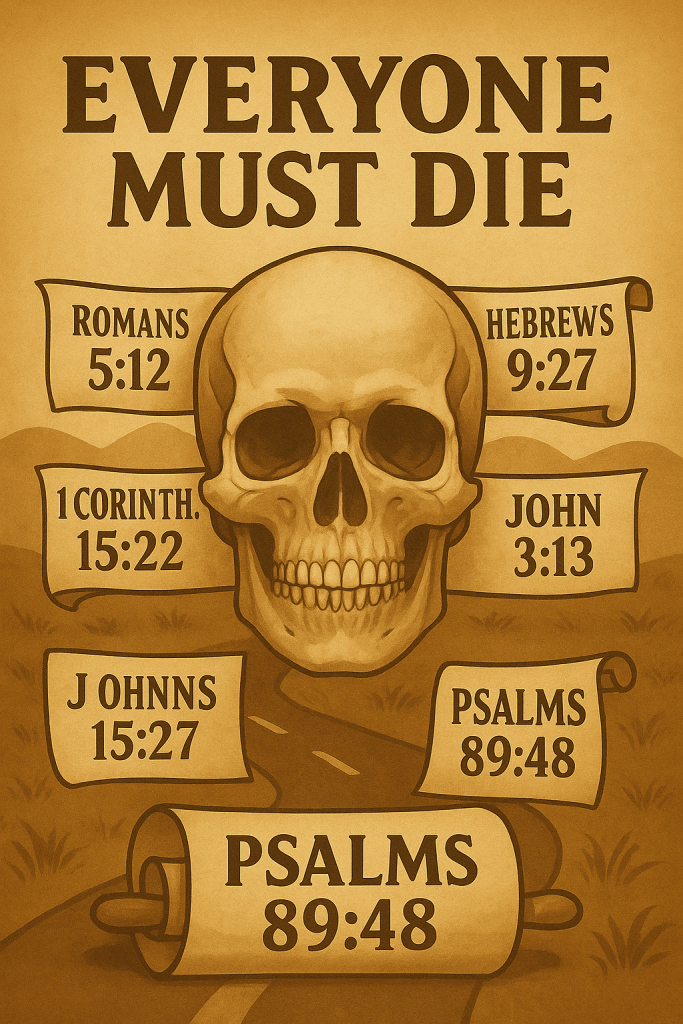
Before we dive into Enoch and Elijah, let’s settle the big question: Does the New Testament leave room for anyone—other than Jesus—to dodge death? Short answer: no. Here are the verses that lock it down.
- Romans 5:12 – “Sin entered the world through one man, and death through sin, and in this way death came to all people.”
Paul isn’t carving out exceptions; “all” means everyone born in Adam’s line. - 1 Corinthians 15:22 – “In Adam all die, so in Christ all will be made alive.”
The pattern is universal death now, universal resurrection later—no secret escape hatch in between. - Hebrews 9:27 – “It is appointed for people to die once, and after that comes judgment.”
A single appointment, the same for prophets and plumbers alike. - John 3:13 – Jesus says, “No one has ascended into heaven except the One who came down— the Son of Man.”
If anyone had already gone up alive and stayed there, Jesus would know. He says nobody has. - 2 Timothy 1:10 – Christ “abolished death and brought life and immortality to light.”
If death were already beaten by Enoch or Elijah, Paul wouldn’t point to Christ as the One who finally did it. - Psalms 89:48 (KJV)
- 48 What man is he that liveth, and shall not see death? shall he deliver his soul from the hand of the grave? Selah.
Put those Scriptures together and it’s clear: every person, no matter how faithful, eventually faces death. Claiming Enoch or Elijah slipped past the grave isn’t just a quirky side belief—it collides head-on with the core New-Testament message that only Jesus breaks death’s grip. With that foundation in place, let’s go back to Genesis and 2 Kings and see what’s really happening with these two men.
Genesis 5:24 (KJV)
24 And Enoch walked with God: and he was not; for God took him.
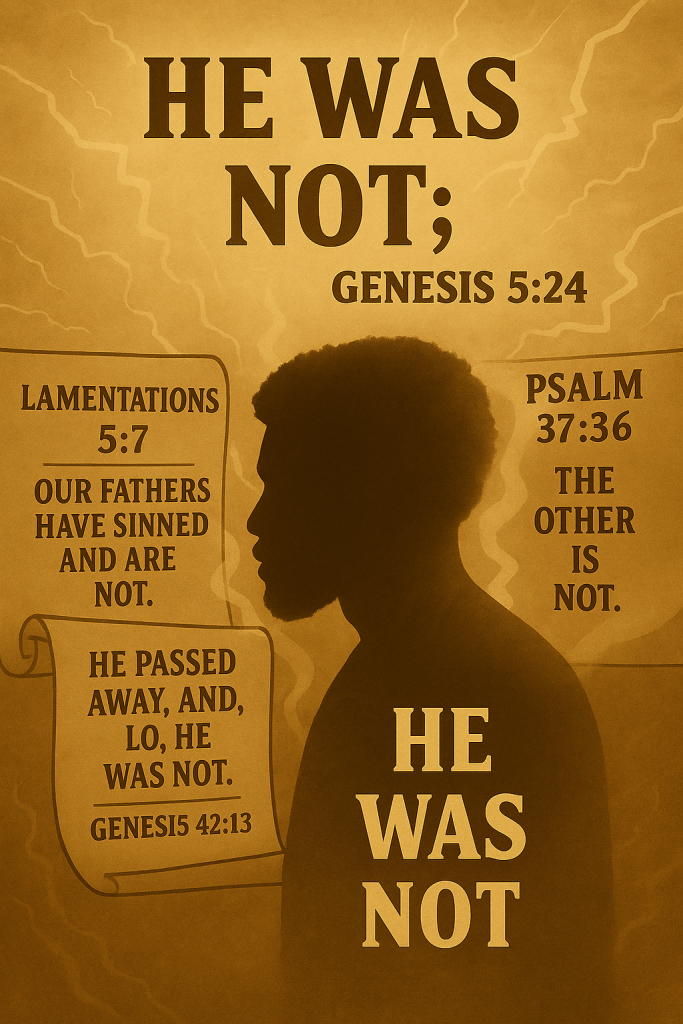
At first glance that sounds like Enoch escaped the grave. But in Scripture the expressions “was not” or “are not” normally mean a person has died—gone from the land of the living. Look at the pattern:
| Passage | Wording | Plain sense |
|---|---|---|
| Lamentations 5:7 | “Our fathers have sinned and are not.” | Our ancestors sinned—now they’re dead. |
| Psalm 37:36 | “He passed away, and lo, he was not; I sought him, but he could not be found.” | The wicked man died and disappeared. |
| Genesis 42:13 (brothers talking about Joseph) | “One is left with our father, and the other is not.” v. 20 repeats, “Your youngest brother… and Benjamin’s brother is not.” | They thought Joseph was dead. |
| Matthew 2:16-18 (quoting Jer 31:15) | Herod kills the infants; Rachel weeps “for her children, and would not be comforted, because they are not.” | The children have been slain—gone from this life. |
See the thread?
Every time the phrase shows up, it’s a concise Hebrew way of saying “dead and gone.”
So back in Genesis 5:24, the straightforward reading is: Enoch lived closely with God, and when his time came, God Himself “took” him—personally handling his death. The verse isn’t a loophole for bodily immortality; it’s the Bible’s own shorthand for a life that ended under God’s care.
Remember the New-Testament foundation we laid earlier: Scripture is clear that only Jesus truly conquered death. Enoch—like everyone else in Adam’s line—did not skip the grave.
Enoch’s “Translation” — What Hebrews 11:5 Really Tells Us
What does “translated” mean?
The Greek verb is metatithēmi (not “metalithium”), which simply means “moved” or “transferred” from one place to another (Acts 7:16; Gal 1:6). It says nothing about immortality, just relocation.
So what happened?
- Enoch did not die a normal “dust-to-dust” death on the spot.
- God “took” him—relocated him—gave him a special death away from human eyes.
- Like every other believer, he now awaits resurrection “at the last trumpet” (1 Cor 15:52; 1 Th 4:16).
But Hebrews 11:13 clears up the timeline.
Just eight verses later, the writer sums up everyone he has mentioned so far—Abel, Enoch, Noah, Abraham, Sarah—by saying “these all died in faith.” Enoch is squarely in that list.
Hebrews 11:13 (KJV)
13 These all died in faith, not having received the promises, but having seen them afar off, and were persuaded of them, and embraced them, and confessed that they were strangers and pilgrims on the earth.
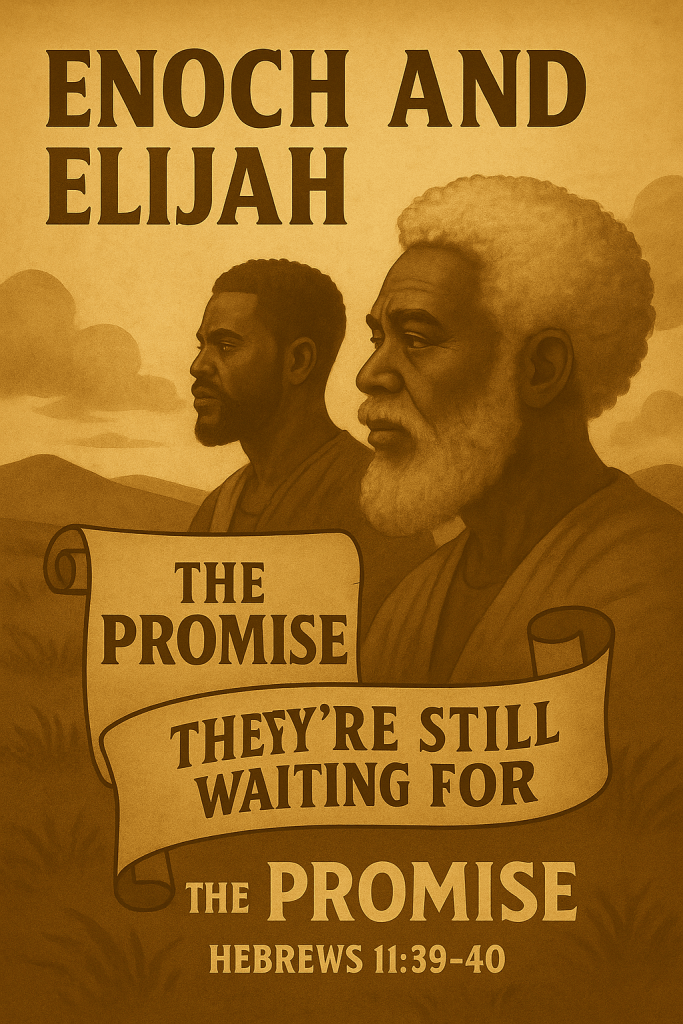
Enoch, Elijah, and the “Promise” They’re Still Waiting For
(Hebrews 11:39–40)
Right after listing Abel, Enoch, Noah, Abraham, Moses, and the prophets, the writer of Hebrews drops this bombshell:
“All these were approved through their faith, yet they did not receive the promise.
God had something better in mind for us, so that they would not be made perfect without us.” (Heb 11:39–40)
Here’s what that means in plain talk:
- “The promise” = the full package of resurrection-life and perfected glory that Jesus secured but hasn’t handed out yet.
- Even though Abraham “obtained” the promise in the sense of having it guaranteed, he didn’t actually receive it—he’s still waiting for the grand opening day, just like we are.
- The same goes for Enoch and Elijah. If either man had already stepped into immortal glory, Hebrews 11:39–40 would make no sense: the verse says none of those heroes has been perfected ahead of the rest of God’s people.
Enoch and Elijah Had a Special Death
Isaiah 57:1-2 (KJV)
1 The righteous perisheth, and no man layeth it to heart: and merciful men are taken away, none considering that the righteous is taken away from the evil to come.
2 He shall enter into peace: they shall rest in their beds, each one walking in his uprightness.
Isaiah 57:1-2 shows that God sometimes grants His faithful ones a quiet, private death to spare them from looming trouble. Enoch was “taken” just before the Flood; Elijah was whisked away before Israel’s final collapse. Neither man dodged the grave—they simply entered a peaceful rest under God’s direct care, exactly the kind of merciful departure Isaiah describes.
Elijah Was Taken to the Sky—But Only for a Special Death
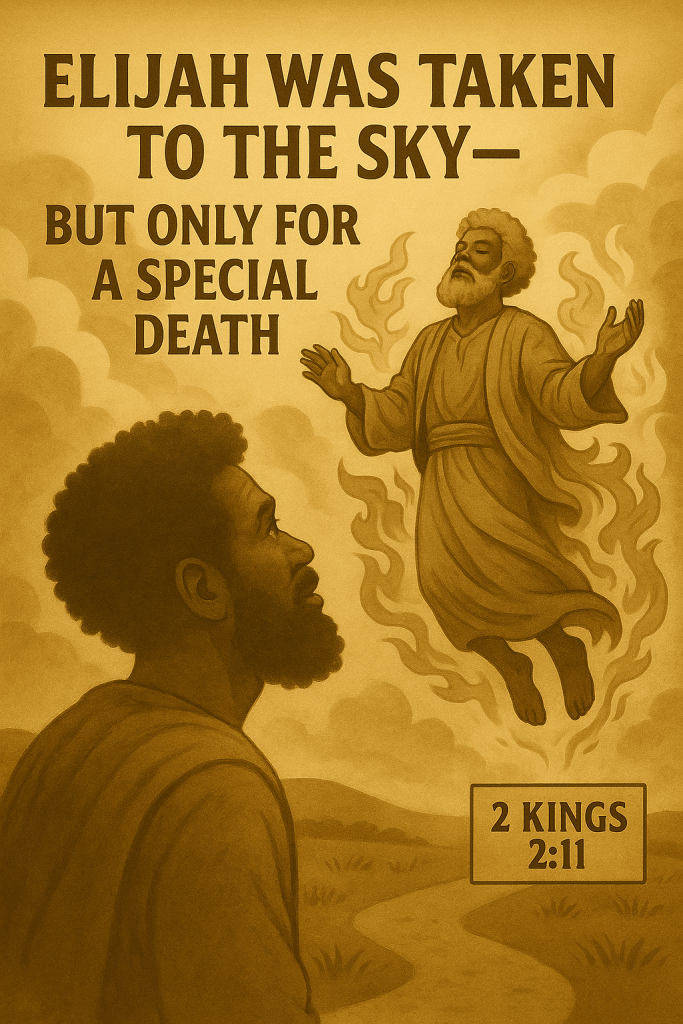
Before we unpack the whirlwind scene, let’s lock in two New-Testament guardrails:
- Jesus lays down the rule
“No one has ascended into heaven except the One who came down from heaven—the Son of Man.”
— John 3:13
If anyone besides Jesus had already rocketed into God’s throne room alive, He would have said so. He didn’t. - Paul explains the gate requirement
“Flesh and blood cannot inherit the kingdom of God … we must be changed.”
— 1 Corinthians 15:50-53
Translation: our ordinary bodies can’t handle heaven. We need the future, glorified upgrade first.
1. The Bible talks about three “heavens.”
| Level | What it means in Scripture | Sample verses |
|---|---|---|
| First heaven | The open sky where birds fly and clouds move. | Gen 1:20; Deut 11:11 |
| Second heaven | The firmament—sun, moon, and stars (outer space). | Gen 1:14–17 |
| Third heaven | God’s direct dwelling-place (Paul calls it “paradise”). | 2 Cor 12:2 |
2. Jesus shuts the door on anyone reaching that third heaven in an ordinary body.
“No one has ascended into heaven except the One who came down from heaven — the Son of Man.”
— John 3:13
If Elijah (or anyone else) had arrived in God’s throne room alive and well, Jesus wouldn’t say this.
3. Paul explains why that’s impossible.
“Flesh and blood cannot inherit the kingdom of God … we must be changed.”
— 1 Cor 15:50-53
You need a glorified, resurrection body to live in God’s realm. Elijah didn’t have that yet.
4. So what happened in 2 Kings 2:11?
“A chariot of fire … and Elijah went up by a whirlwind into heaven.”
- The Hebrew word shamayim (“heaven”) can mean any of the three levels.
- Context points to the first heaven—the sky. Elijah is lifted off the ground and out of sight, not transported into God’s throne room.
. Putting it all together
- Where was Elijah taken? Into the sky (first heaven), away from prying eyes.
- Why? To spare him Israel’s coming judgment and to grant him a peaceful, private death, just as Isaiah describes.
- Did he beat death? No. He died under God’s protection and, like every believer, now waits for resurrection and a glorified body when Christ returns.
What about Matthew 17?
Moses and Elijah on the mountain—was that proof Elijah’s still alive in heaven?
No. Matthew himself tells us the scene was a vision, not a permanent, bodily return
Matthew 17:1-7 (KJV)
1 And after six days Jesus taketh Peter, James, and John his brother, and bringeth them up into an high mountain apart,
2 And was transfigured before them: and his face did shine as the sun, and his raiment was white as the light.
3 And, behold, there appeared unto them Moses and Elias talking with him.
4 Then answered Peter, and said unto Jesus, Lord, it is good for us to be here: if thou wilt, let us make here three tabernacles; one for thee, and one for Moses, and one for Elias.
5 While he yet spake, behold, a bright cloud overshadowed them: and behold a voice out of the cloud, which said, This is my beloved Son, in whom I am well pleased; hear ye him.
6 And when the disciples heard it, they fell on their face, and were sore afraid.
7 And Jesus came and touched them, and said, Arise, and be not afraid.
Matthew 17:8-9 (KJV)
8 And when they had lifted up their eyes, they saw no man, save Jesus only.
9 And as they came down from the mountain, Jesus charged them, saying, Tell the vision to no man, until the Son of man be risen again from the dead.
When the vision fades, “they saw no one except Jesus only” (Mt 17:8).
The point is that, even for those few moments, Moses (representing the Law) and Elijah (the Prophets) step aside so the Father’s voice can say, “This is My beloved Son … listen to Him.”
Why the vision matters.
It’s God’s dramatic way of saying, “The age of the Law and the Prophets has served its purpose; now all eyes on Jesus.” The spotlight shifts from past heroes to the One who will actually conquer death.
Bottom line: Enoch and Elijah didn’t cheat death; they experienced a unique, God-managed departure and now rest until the same resurrection day we all anticipate—keeping the spotlight on Jesus, the only One who truly conquered the grave. The only people that will not die are the believers that is alive during the second coming of Jesus.



Thank you for this detailed breakdown with the neccessary passages and verses to support this teaching.
LikeLiked by 1 person
i believe what you said is true but what about the second coming, some will not see death and experience his return.
LikeLike