
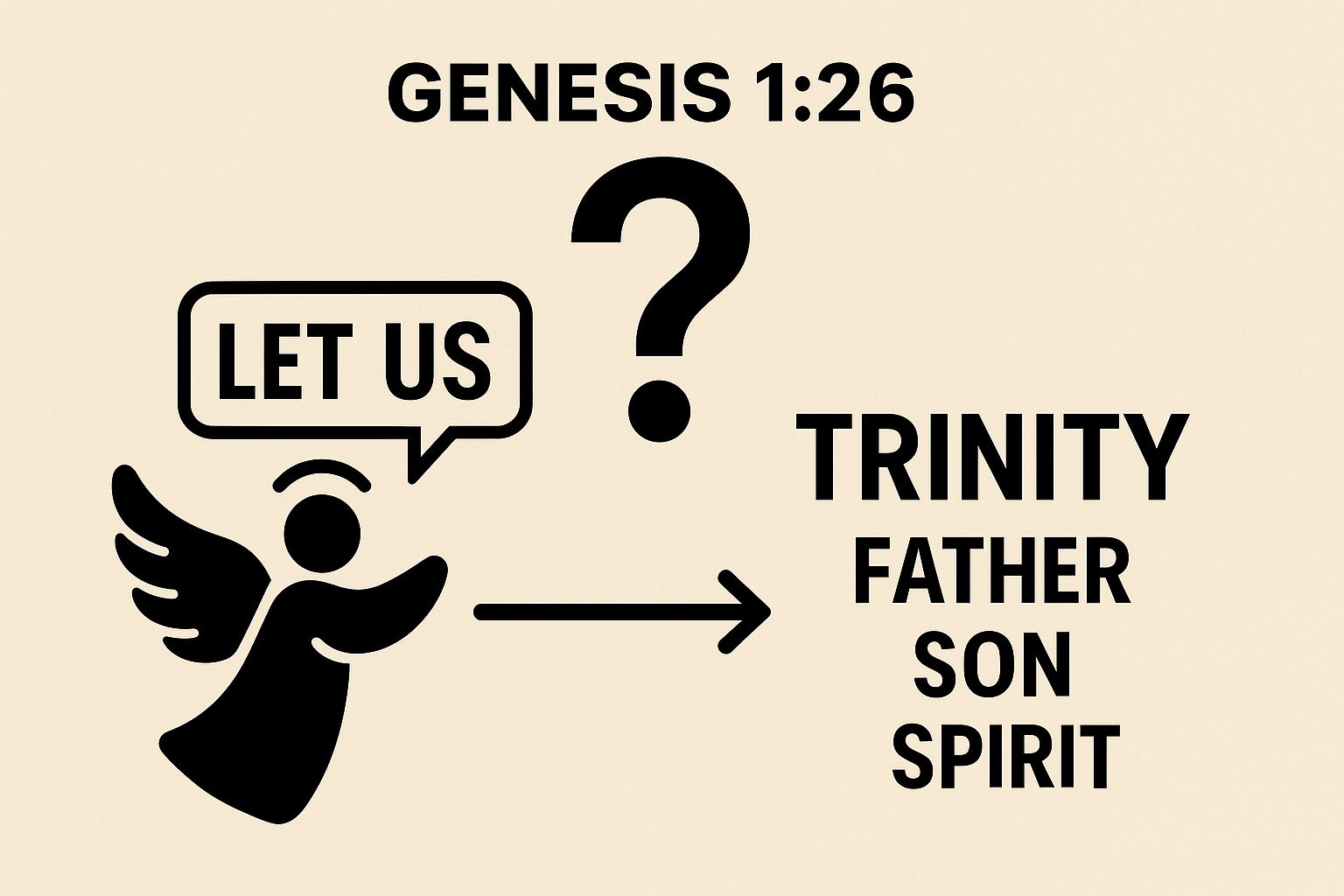
Gen 1:26
26 And God said, Let us make man in our image, after our likeness: and let them have dominion over the fish of the sea, and over the fowl of the air, and over the cattle, and over all the earth, and over every creeping thing that creepeth upon the earth.
A lot of people get stuck on Genesis 1:26 because of the plural wording: “Let us make man in our image.”
From this one line, three major views pop up everywhere:
- God was talking to Himself — like a reflective or poetic self-conversation.
- God was talking to angels (or “the Gentiles”) — as if angels helped create mankind.
- The Father was speaking to the Son and the Holy Spirit — the plural showing the unity of the Godhead.
These are the three main explanations you’ll hear, and the goal of this article is simple:
Look at the text, compare Scripture with Scripture, and show which view actually fits the Bible.
We’re not coming with assumptions.
We’re letting the passage speak for itself.
What it means to be made in God’s image
Before we address who God is talking to in Genesis 1:26, we need to first understand what it means to be made in His image.
And the verse actually explains it:
“…let us make man in our image, after our likeness: and let them have dominion…” (Genesis 1:26)
Right there — the definition is in the sentence.
Being made in God’s image means:
God has dominion over the universe man was created to have dominion over the earth.
The same way God rules everything He created
Man was formed to rule what God put under him.
Not to be God,
not to be divine,
not to be equal with God…
But to reflect God’s authority in a smaller, earthly way.
Just like:
- God reigns over heaven and earth,
- Man reigns over the animal kingdom and the earth.
This is why the verse immediately connects:
“in our image…”
“…and let them have dominion.”
The “image” isn’t talking about God having a human body.
It isn’t talking about physical form.
It’s about function — authority, rulership, order.
Man reflects God by ruling what God placed under him.
Who Is the “Us”?
When the Bible reaches the creation of man, the language suddenly changes:
“And God said, Let us make man in our image, after our likeness…”
That phrase, “Let us,” has been debated heavily.
But when you look at the context and the logic of Scripture, the answer becomes clear.
Some people claim God was talking to the ground,
as if dirt helped create humans.
That makes no sense:
- Dirt doesn’t design souls
- Dirt doesn’t think
- Dirt doesn’t create beings “in God’s image”
Genesis 2:7 makes it clear:
Gen 2:7
7 And the LORD God formed man of the dust of the ground, and breathed into his nostrils the breath of life; and man became a living soul.
God formed man.
God breathed life.
God gave the soul.
So that view gets dropped.
The “Us” Is Not the Angels
Some say God was talking to angels.
But angels:
- can’t create
- don’t give life
- can’t share God’s image
- were NOT present as co-creators
Scripture says God created:
“alone… by Himself.” (Isaiah 44:24)
Isa 44:24
24 Thus saith the LORD, thy redeemer, and he that formed thee from the womb, I am the LORD that maketh all things; that stretcheth forth the heavens alone; that spreadeth abroad the earth by myself;
If angels helped, then man would be in the image of angels — not God.
So that view drops too.
So Who Is the “Us”?
The only view that fits:
The Father speaking to the Son and the Holy Spirit.
Why?
Because:
- All three Persons show up in creation
- The Spirit is already moving on the waters (Genesis 1:2)
Gen 1:2
2 And the earth was without form, and void; and darkness was upon the face of the deep. And the Spirit of God moved upon the face of the waters.
- The Word created all things (John 1:3)
Joh 1:3
3 All things were made by him; and without him was not any thing made that was made.
- Scripture speaks of God as “Makers” in the plural we going to prove that soon
Why Does God “Consult” Here?
Not because He needed help,
but because man is different from all other creation.
Everything before man was created by a simple command:
“Let there be…”
But with man, the tone shifts:
“Let us make…”
It signals:
- man’s dignity
- man’s purpose
- man’s spiritual nature
- man being made closest to God’s likeness
What It Means to Be Made in God’s Image
The verse itself explains it:
A. Soul
Man is spiritual, intelligent, moral — like God.
B. Dominion
God rules the universe.
Man rules the earth under God.
“Let them have dominion…”
C. Moral Purity
Before sin, humanity walked in holiness, clarity, and obedience.
Ecc 7:29
29 Lo, this only have I found, that God hath made man upright; but they have sought out many inventions.
This is the part sin ruined.
Scripture speaks of God as “Makers” in the plural.
Ecc 12:1 KJV
Remember now thy Creator in the days of thy youth, while the evil days come not, nor the years draw nigh, when thou shalt say, I have no pleasure in them;
Now before we break this down, let me show you what you’re actually looking at on the screen. When you read this verse in English — ‘Remember now thy Creator’ — it sounds simple, right? Singular. One Creator. Nothing complicated.
But the moment you leave the English and actually look at the original language this verse was written in… everything changes.
When we pull up the Hebrew text, the word translated ‘Creator’ is not singular. It is 100% plural. The Hebrew literally reads, ‘Remember your Makers.’ Not Maker — Makers.”
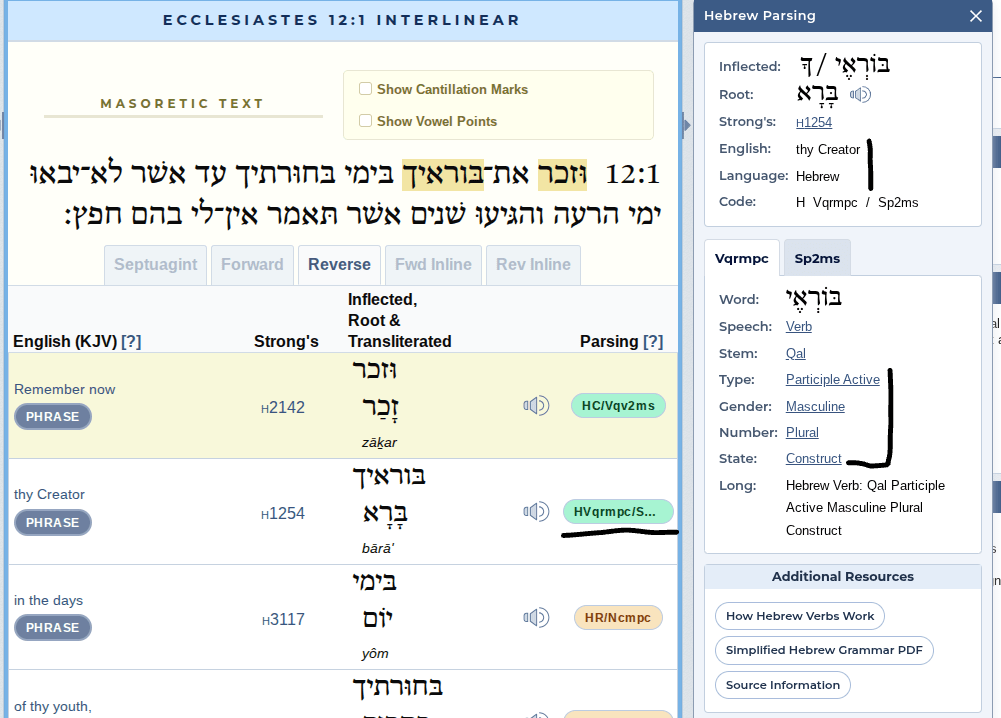
“You see that? The form of the word is masculine plural, active participle. The Hebrew grammar forces it to mean Makers. The only reason English translations smooth it out into the singular is because English doesn’t normally use plural titles for God — but the Hebrew does.”
This is why I always tell people: if your doctrine stands only in English… it’s fragile
But There Is One Translation
Now, one English translation actually preserves the Hebrew grammar instead of smoothing it out. The Young’s Literal Translation the YLT doesn’t hide the plural.
Ecc 12:1 (YLT)
1 Remember also thy Creators in days of thy youth, While that the evil days come not, Nor the years have arrived, that thou sayest, ‘I have no pleasure in them.’
That’s the correct rendering. That’s the Hebrew.
Why Hebrew Uses a Plural Here
More than one Person was involved in creation
just like Genesis 1:26,
“Let us make man…”
The Hebrew supports that:
- The Father created us (Malachi 2:10)
Mal 2:10
10 Have we not all one father? hath not one God created us? why do we deal treacherously every man against his brother, by profaning the covenant of our fathers?
- The Son created us Colossians 1:16)
Col 1:16
16 For by him were all things created, that are in heaven, and that are in earth, visible and invisible, whether they be thrones, or dominions, or principalities, or powers: all things were created by him, and for him:
- The Spirit created us (Job 33:4)
4 The Spirit of God hath made me, And the breath of the Mighty doth quicken me.
All three are called Creator in Scripture.
3. Angels Are Not the “Creators”
- Angels didn’t create mankind (Hebrews 1:10–14)
14 Are they not all ministering spirits, sent forth to minister for them who shall be heirs of salvation?
- Mankind is not made in the image of angels
- Angels themselves are created beings
Ecclesiastes 12:1 uses a plural because the Triune God was the one who made man — not angels.
What “Parsing a Word” Even Means
Now just so y’all know what I’m doing here — I’m not hunting for ten different meanings or random definitions. I’m not doing word gymnastics. I’m literally parsing the word. Meaning: I’m looking directly at the exact Hebrew form used in this verse, Ecclesiastes 12:1, to see how the grammar actually works.
Parsing just means I’m checking the word’s shape — is it singular, is it plural, what tense is it in — not what it could mean in other verses, but what it is in this verse.
And when you parse it — when you look straight at the Hebrew grammar — the word is not singular. It is plural. It literally reads ‘your Makers.’”
Job 35:10
10 But none saith, Where is God my maker, who giveth songs in the night;

The English Says “My Maker” (Singular)
But the Hebrew Says “My Makers” (Plural)**
“But none saith, Where is God my Maker?”
But the Hebrew form used here is עֹשָׂי — my Makers — masculine, plural.
This is not an accident and not a poetic mistake.
The grammar forces the plural.
Job is literally asking:
“Where is God, my Makers?”
Summary
This study showed that when God said, “Let us make man” in Genesis 1:26, He was not speaking to the earth, not speaking to angels, and not using fancy royal language. The original Hebrew and the rest of Scripture point to something much deeper: the Father, the Son, and the Holy Spirit were together in the creation of mankind.
We proved this by looking at the Hebrew words behind verses like:
- Genesis 1:26 — “Let us make man”
- Job 35:10 — “God my Makers” (Hebrew: plural)
- Ecclesiastes 12:1 — “Remember thy Creators” (Hebrew: plural)
In every place where creation is mentioned in Hebrew, the grammar keeps showing this same pattern:
God is one in essence, but plural in Persons.
We also saw that angels never created anything and were never included in the image of God, which removes them completely from Genesis 1:26. And the “royal plural” theory doesn’t even fit the Old Testament usage.
God used the language of “Let us” — not because He needed help, but because the creation of mankind was a unique act that displayed the dignity and worth of the human race, made in the image and likeness of God.
If Scripture calls God our “Makers,” then the question becomes simple —
Who created us?
The Bible consistently answers:
- The Father created
- The Son created
- The Holy Spirit created

 The Bible Vault
Overall, this is a great answer to the question, who is “US.” I am new to the study of theology, and my understanding of the Trnity. The Son represents Jesus Christ, and he is a result of the fall of man, a reaction. How can Christ be the “US” if he was not part of the original design? God would have known that mankind would have disobed, “and God saw that it was good.”
LikeLike
I Learn
LikeLike