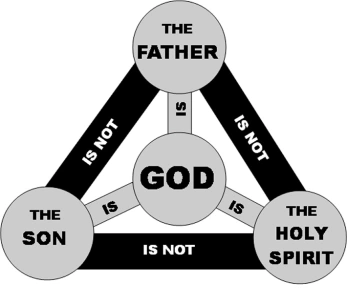
The Trinity means there is one God — one divine essence — shared fully and eternally by three Persons:
• The Father • The Son • The Holy Spirit
Not three Gods. Not one Person shapeshifting into three roles. One divine nature, three distinct persons.
Each Person is God, yet each Person is not the other:
The Father is God The Son is God The Holy Spirit is God
The Father is not the Son The Son is not the Spirit The Spirit is not the Father
Absolute unity in nature. Distinction in personhood. No hierarchy, no division, no conflict because to disagree would mean God is divided, which is impossible.
Where the Word Trinity Comes From
The word Trinity never appears in the Bible — but the doctrine is everywhere in Scripture.
The term was created later as a helpful way to summarize what the Bible already teaches:
Tri → meaning three Unity → meaning oneness
When those two ideas are fused together, you get:
Tri + Unity = Trinity meaning Three in Unity.
Not three gods. Not one Person in three forms. But three distinct Persons who share one unified Divine Essence.
Father = God by nature Son = God by nature Holy Spirit = God by nature
Yet there is still only one God, because God refers to what They are — the one divine nature — not how many Persons possess that nature.
When people hear the word “Trinity,” most minds jump straight into arguments, debates, and complicated explanations. But before we even touch any of that, we have to slow down and deal with one simple question:
What do we mean when we say “God is One”?
Because if we don’t define that clearly, everything else becomes confusion.
Scripture doesn’t present God as three beings. Scripture doesn’t present God as three essences. Scripture doesn’t present God as three separate gods working together.
The Bible presents one divine Being one essence one nature.
And this is the foundation the whole Trinity rests on.
The Father has this divine essence. The Son has this divine essence. The Holy Spirit has this divine essence.
Not three essences. Not three gods with similar power. One divine nature fully shared by three distinct Persons.
This first part of the series is not about proving every passage, debating every movement, or trying to win an argument. This is the foundation. This is the anchor point. This is the part Israelite camps skip, OT only readers avoid, and even many Christians never slow down to understand.
Because once you grasp what essence means, and what “one God” actually means, the rest of the Trinity becomes simple and natural — because the Bible reveals one divine essence shared fully by Father, Son, and Spirit.
So before we move into the “how,” the “who,” and the “where,” we start with the most important step:
What We Mean by “One God”
Deu 6:4
4 Hear, O Israel: The LORD our God is one LORD:
This is the core message:
Israel’s God isn’t many gods like the nations believed.
He is one self-existent, eternal, all-powerful Being.
One essence. One divine nature.
No room for idolatry, blending, or splitting God into different “gods.”
Does this contradict the Trinity?
Not at all.
This verse talks about God’s unity, not the number of persons in that unity.
“LORD” is the one Divine Being, but within that Divine Being Scripture reveals:
the Father,
the Word (Son),
and the Spirit.
All three share that one divine name — that’s why the Bible can still say:
The LORD is one.”
You don’t have three gods. You have one God, shared by three persons.
Deuteronomy 6:4 teaches that God is one in essence, one in being, one divine nature. The rest of Scripture reveals that this one God is Father, Son, and Spirit. Not three gods — one LORD, shared by three divine persons.
Essence.
Essence simply means the substance or nature that makes you what you are. It’s the “what” behind your existence.
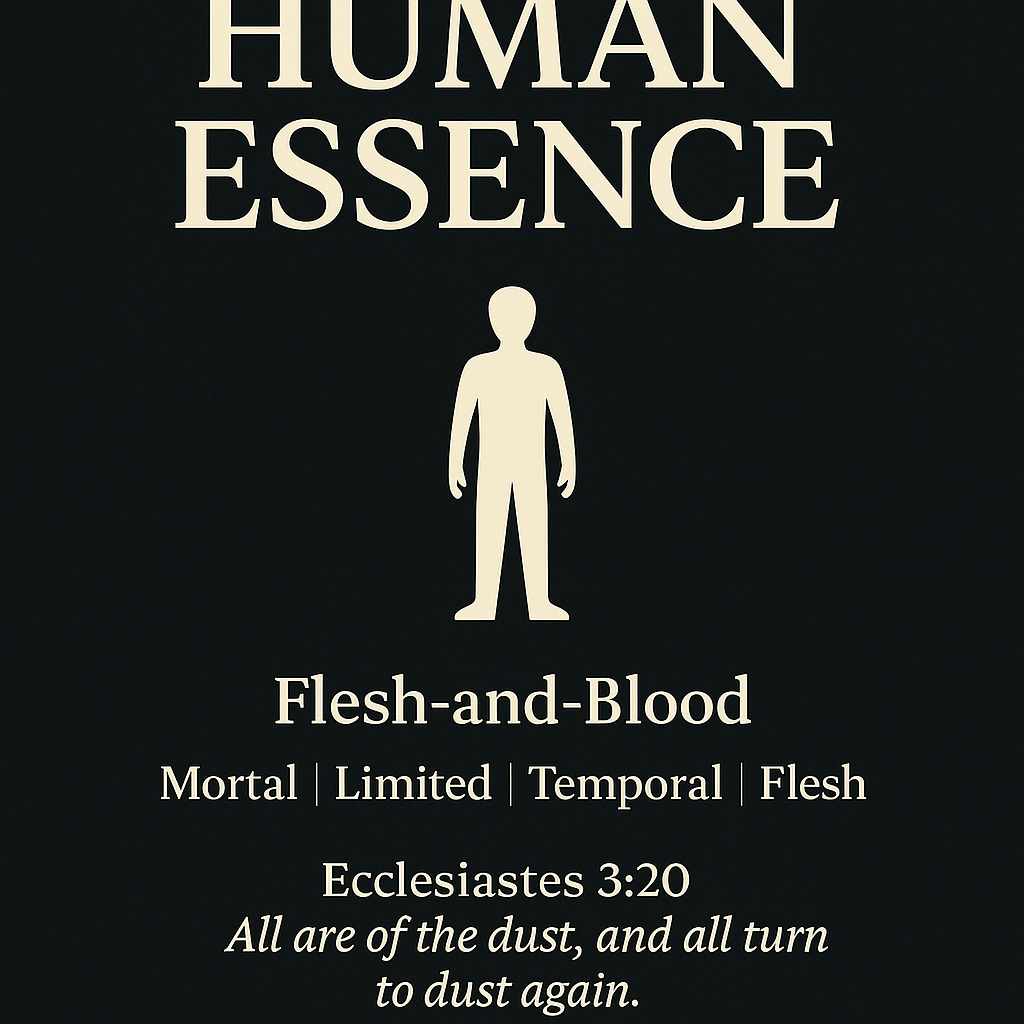
Human Essence (Nature): Flesh-and-Blood
A human’s Essence is simple:
Flesh and blood.
That is what makes a human… human.
Weak
Limited
Mortal
Bound to space and time
Billions of us exist, but we all share this one human Essence.
Different personalities, same nature.
Ecclesiastes 3:20 All are of the dust, and all turn to dust again.
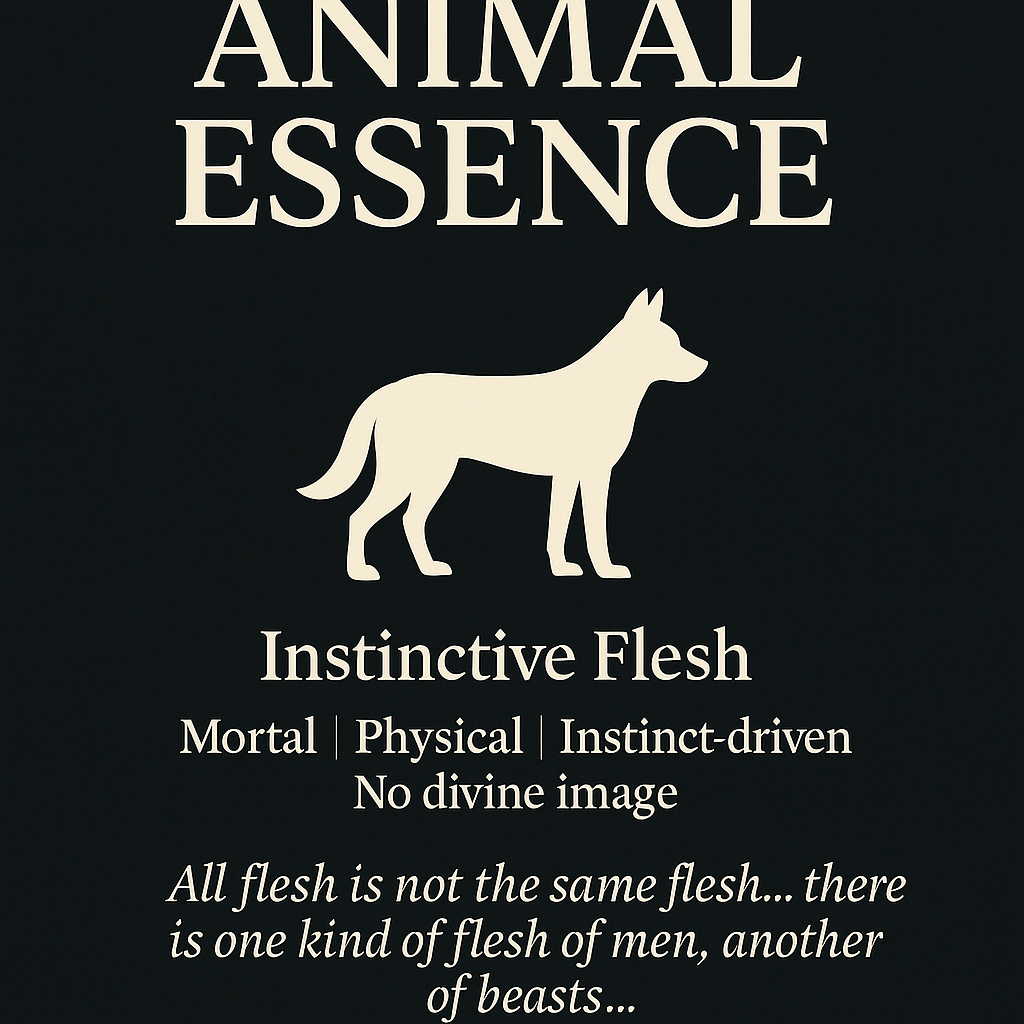
Animal Essence: Instinctive Flesh
Animals also have their own Essence.
Mortal
Physical
Instinct-driven
No divine image ( Animals are not made in God image)
Animal Essence is different from human Essence.
That’s why an animal cannot think like you, reason like you, or worship like you. Different Essence = different existence.
1 Corinthians 15:39 All flesh is not the same flesh… there is one kind of flesh of men, another of beasts…
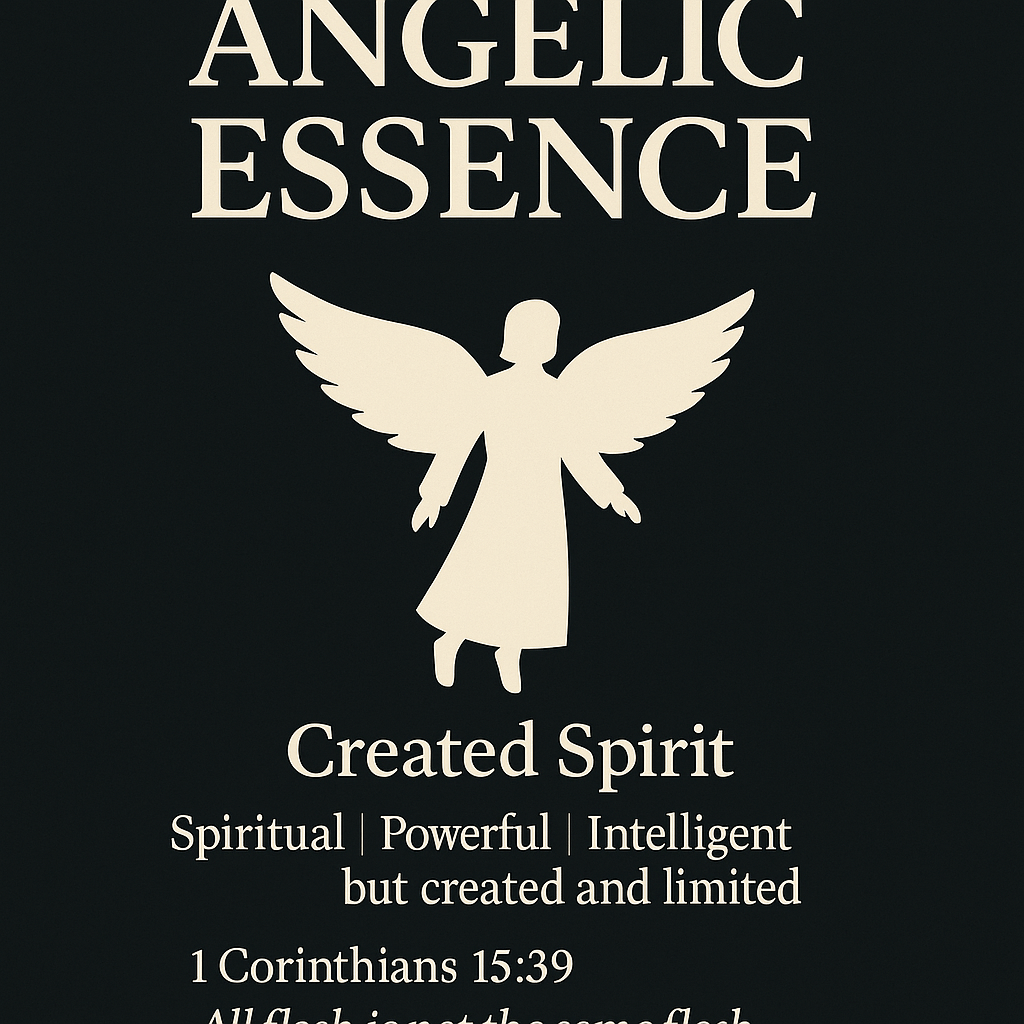
Angelic Essence: Created Spirit
Angels are another category.
They are:
spiritual
powerful
intelligent
but created
and limited
Their Essence is created spirit, not flesh, not divine. They exist in the spiritual realm, but they are not eternal, not omnipresent, not omnipotent.
They are creatures.
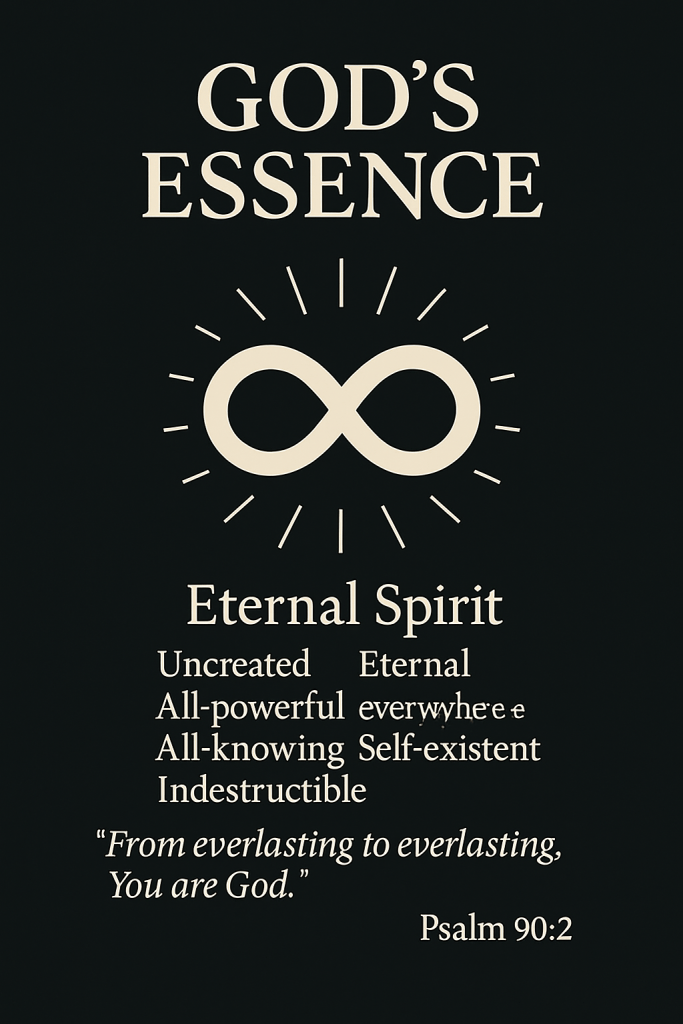
God’s Essence: Eternal Spirit
God is on a completely different level.
John 4:24 says:
God is Spirit.
But this is not the same kind of spirit angels have.
God’s Essence is:
Uncreated
Eternal
All-powerful
Everywhere at once
All-knowing
Self-existent
Indestructible
This is the Divine Essence a nature that no creature can share unless it is truly God.
Psalm 90:2 “From everlasting to everlasting, You are God.”
1Ti 1:14-16
14 And the grace of our Lord was exceeding abundant with faith and love which is in Christ Jesus.
15 This is a faithful saying, and worthy of all acceptation, that Christ Jesus came into the world to save sinners; of whom I am chief.
16 Howbeit for this cause I obtained mercy, that in me first Jesus Christ might shew forth all longsuffering, for a pattern to them which should hereafter believe on him to life everlasting.
In verses 1 Tim 1:12–16, Paul thanks Christ for:
putting him into ministry
showing him mercy
saving him as “chief of sinners”
displaying long-suffering toward him
Then immediately he says:
1 Timothy 1:17 Now unto the King eternal,immortal, invisible, the only wise God,be honour and glory for ever and ever. Amen.
The praise naturally continues toward the One he was describing — Jesus.
King Eternal
Jesus isn’t a temporary ruler — His kingship never ends.
Psalm 145:13 — “Your kingdom is an everlasting kingdom.” Hebrews 1:8 — “Your throne, O God, is forever and ever.”
Only a divine King reigns eternally.
Immortal / Incorruptible
Christ died once in the flesh (his God nature didn’t die) but never dies again.
Revelation 1:18 — “I am alive for evermore.” Hebrews 7:25 — “He ever liveth to make intercession.”
Immortality belongs to God alone and Jesus possesses it.
Invisible
People saw His body but His divine essence was never seen.
He was invisible in nature until He took flesh, and now His glorified body is hidden from physical sight.
John 1:18 — “No man hath seen God at any time.” Colossians 1:15 — “The image of the invisible God.”
His humanity was visible. His God-nature was not.
The only God” / “The God who alone is God”
The Greek manuscripts read:
“the only God” (not “only wise God”)
This doesn’t mean:
the Father is God instead of the Son
or excluding the Spirit
It means:
Only the God of Scripture is truly God — not idols, not false deities.
The grammar is:
To the eternal King, the immortal, the invisible, the only God — be honor and glory forever.
Jeremiah 23:24 God fills heaven and earth omnipresent.
The reason God can be everywhere all at once is because of the nature/essence that he has that’s what makes him God. That one essence is shared between The Father, Son and Holy spirit.
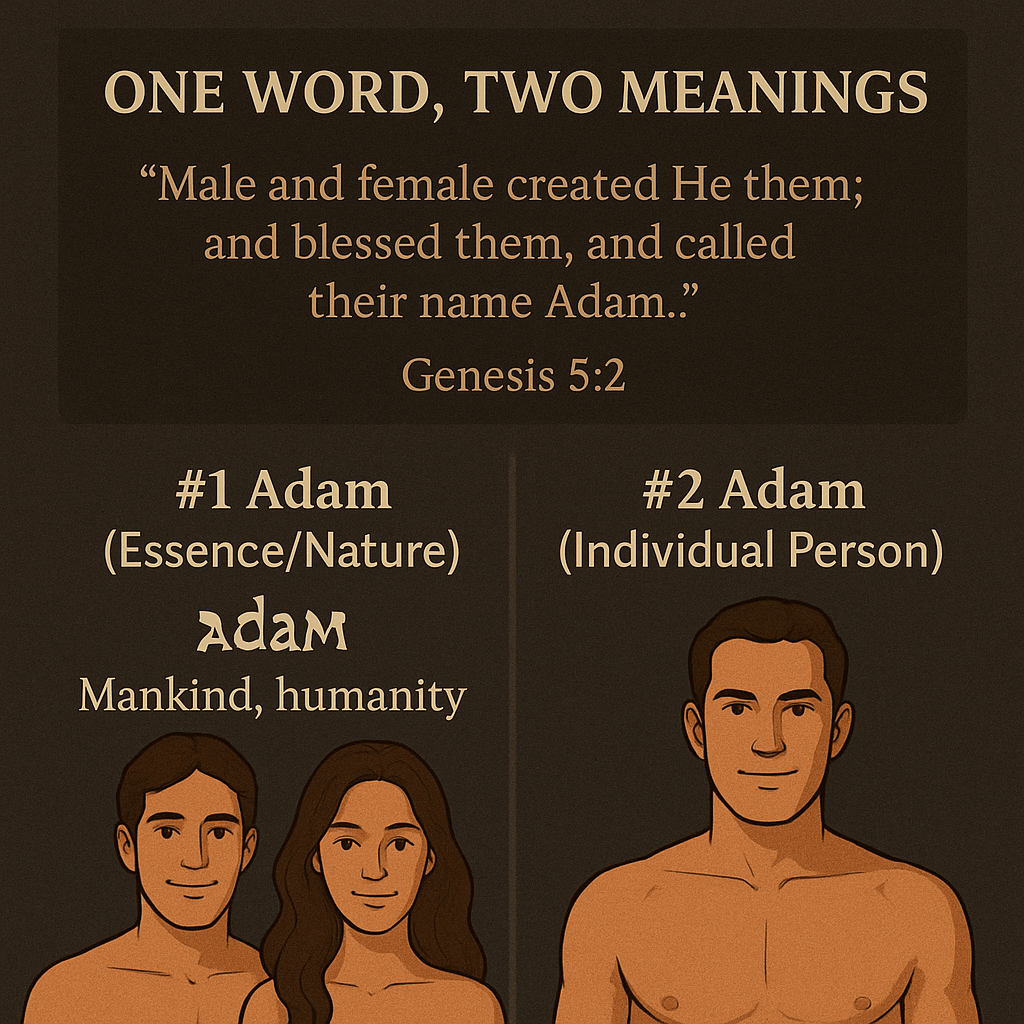
Genesis 5:2 Adam Used Two Ways
Male and female created He them; and blessed them, and called their name Adam… (Genesis 5:2)
The verse says both were called Adam. Not just the man — Adam and Eve together are “Adam.”
So now we have two uses of the word:
1. Adam (Nature / Essence)
Hebrew — אָדָם (Adam) = mankind, humanity
This refers to what they are. Adam = human nature. Both Adam and Eve share this essence. Same flesh. Same nature. Same humanity.
Both are Adam — because both are human.
Adam (Person / The Male Individual)
This refers to the man himself — the person.
Eve is Adam by essence (human), but Eve is not Adam the male individual.
Two different persons. One shared nature.
So What Does This Show?
One word — two layers of meaning
Essence (what)
Person (who)
Eve and Adam share the same human essence
But they are not the same person
1Ti 2:14
And Adam was not deceived, but the woman being deceived was in the transgression.
Notice here they are using Adam to refer to the male rather than the nature , even though Eve is also called Adam in Genesis 5, this verses makes a separation because Adam here is the person/male Adam not the nature ( mankind)
This is the exact logic John uses in John 1:1.
Now Apply That Logic to John 1:1
“In the beginning was Eve, and Eve was with Adam, and Eve was Adam.”
Meaning:
Eve was with Adam (two persons, not confused)
Yet Eve was Adam (sharing one human essence)
Eve is human because she came from Adam
She is not him, but she is what he is.
How This Helps Us Understand Jesus
Jesus is not the Father, but He is what the Father is — God.
Just like:
Person
Essence
Adam ≠ Eve
both are human
Father ≠ Son
both are God
Just like Adam and Eve showed:
Adam = one name used two ways
Adam (the man / person)
Adam (the nature — mankind)
Eve is not Adam the man, but Eve is Adam by essence — she is human.
One essence → two persons.
Joh 1:1
1 In the beginning was the Word, and the Word was with God, and the Word was God.
“In the beginning was the Word”
The Word = Christ Himself, not a book.
He created all things (v.3)
He is life & light (v.4)
He becomes flesh (v.14)
He is worshipped, obeyed, sent, incarnate
This means:
Jesus existed before creation Jesus is eternal — Not made, not created Jesus is the Word as the Son of God
Rev 19:13
13 And he was clothed with a vesture dipped in blood: and his name is called The Word of God.
Just like thought is born from mind, The Word is eternally from the Father.
This doesn’t mean the Word began. It means the Word already existed before the beginning began.
Not created
Not formed later
Already there when time started
Scripture elsewhere confirms this eternal identity:
Verses
What it shows
John 17:5
The Word existed with the Father before the world
Ephesians 1:4
Christ was known before creation
Col. 1:15
“Begotten before all creation” (not created — eternal Son)
Heb. 1:8
The Son is addressed as God from eternity
The Word was WITH God” → Person
“With God” = beside, in fellowship, face to face.
This teaches:
The Word is not the Father
The Word is a distinct Person
The Son existed with the Father eternally
Just like Eve was “with Adam,” but still not Adam the man.
Two persons are present.
This phrase already destroys:
Oneness modalism The idea Jesus is the Father The idea the Son didn’t exist until Bethlehem
Because they were with each other before creation ever existed.
“The Word was God” → Essence
Now John shifts from person to nature.
Not:
the Word became God the Word was a God the Word was like God
But:
The Word WAS God Same essence. Same nature. Same divinity.
Meaning:
What the Father is by nature, the Son is also.
The Father is God.
The Son is God in the same way — eternal, uncreated, almighty.
Adam Example
John 1:1 Example
Eve was Adam (essence — human)
The Word was God (essence — divine)
Eve was with Adam (distinct person)
The Word was with God (distinct person)
Same nature, different persons
Same nature, different persons
Adam & Eve = one humanity Father & Son = one Divinity
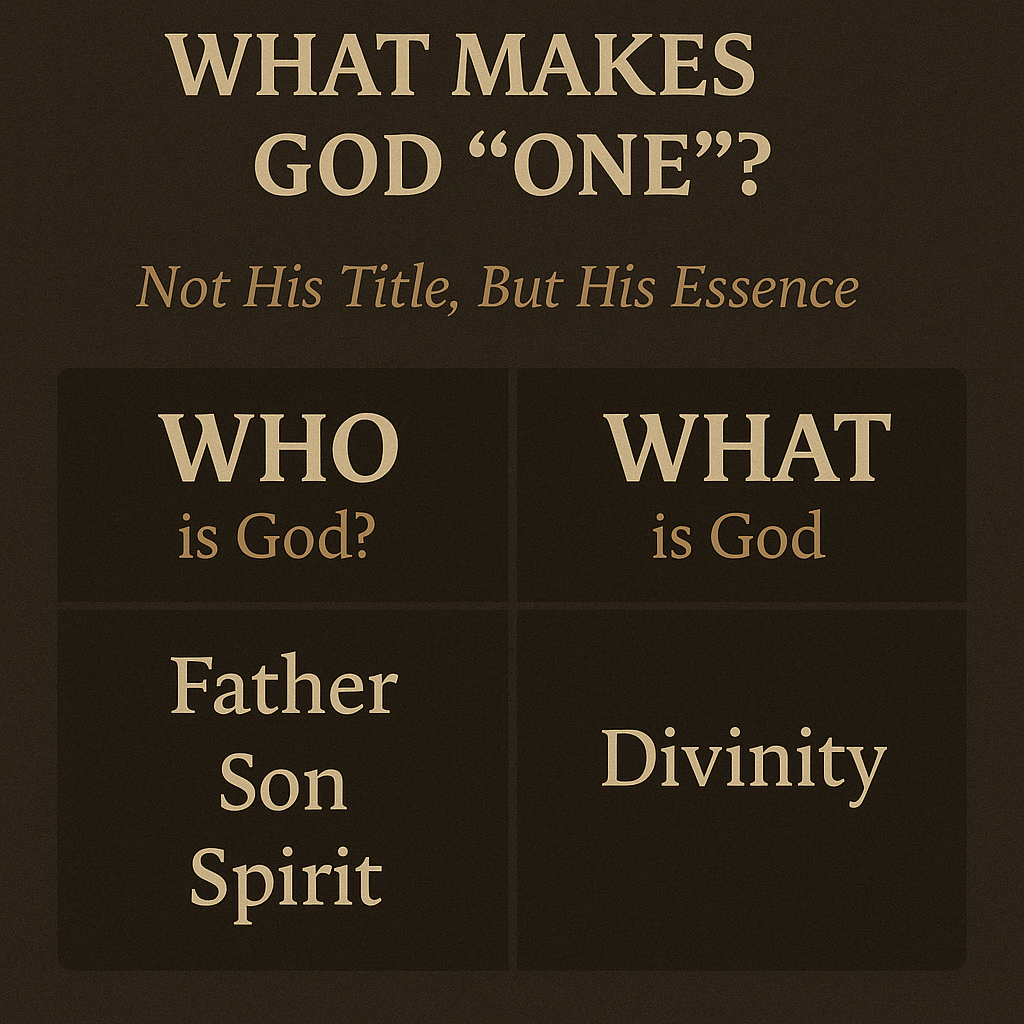
What Makes God “One”?
Not His Title, But His Essence
When Scripture says:
There is only one God” (Deut. 6:4)
the question must be asked:
One what exactly?
One Person? or one Divine essence?
Because the word “God” can describe two things:
Question
Category
Who is God?
Person (Father, Son, Spirit)
What is God?
Nature (Divinity itself)
A name tells you who someone is. A nature tells you what they are.
Example:
Who I am: Eleazar
What I am: Human (flesh & blood nature)
My name does not make me human. My nature does.
The Father is Father because of relational identity, but He is God because of His nature, not His role.
And that Divine nature is shared — not divided.
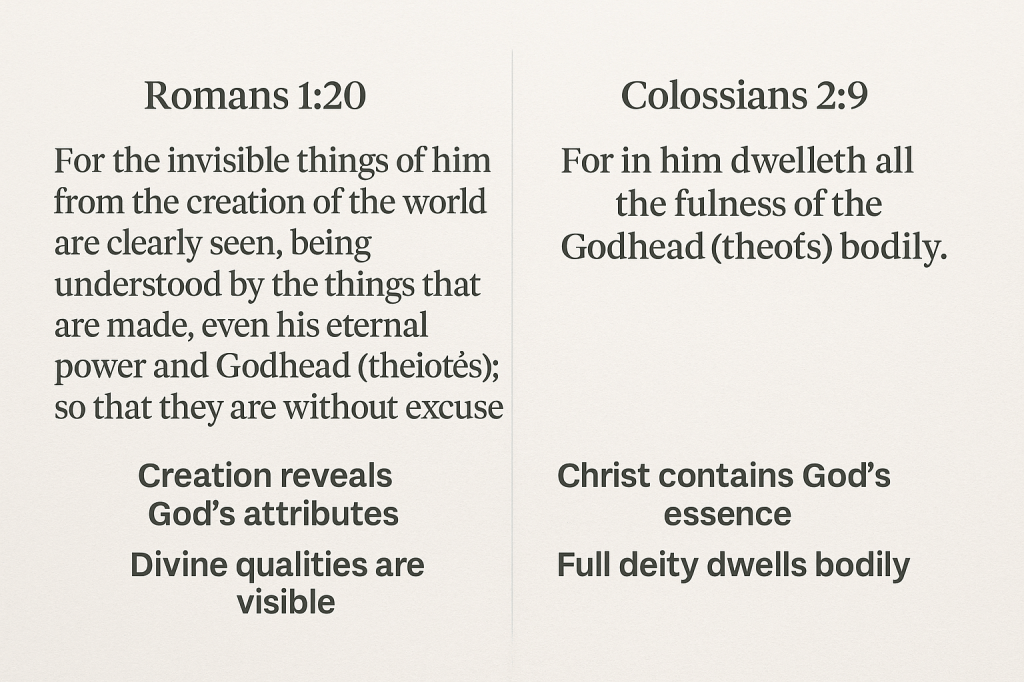
Colossians 2:9 — Fullness of Deity in Christ
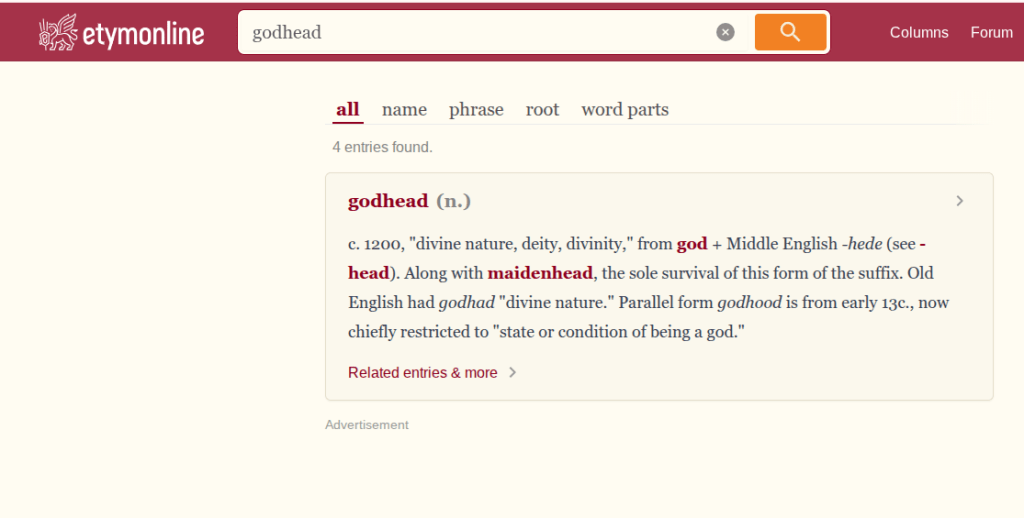
In Him dwells all the fullness of the Godhead bodily.”
Not partly God. Not similar to God. Not reflecting God.
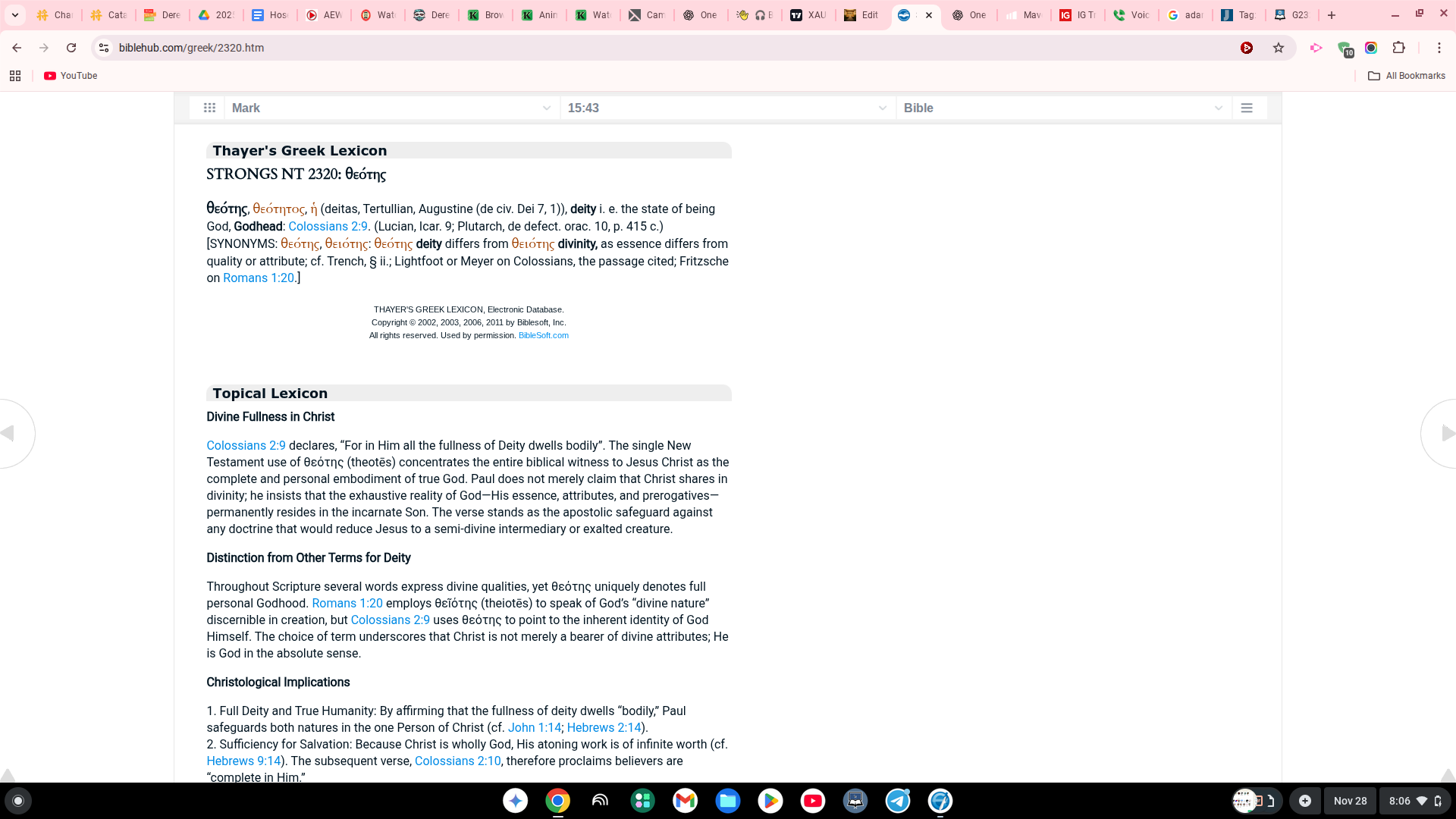
The Greek word here is θεότητος — Theotēs This word appears only once in the NT, and BibleHub makes the meaning unmistakable.
What Theotēs Means:
Not divinity… but full Deity. Not “God-like”… but what God is in essence.
The two key Greek words:
Greek Word
Meaning
θεότης (Theotēs)
Deity itself — the essence of God
θειότης (Theiotēs)
Divinity — divine qualities, not full essence
Rom 1:20
20 For the invisible things of him from the creation of the world are clearly seen, being understood by the things that are made, even his eternal power and Godhead; so that they are without excuse:
Colossians 2:9 uses θεότης (Theotēs) — the stronger word.
Paul uses the strongest possible word for God-essence
He switched vocabulary intentionally to make the point airtight:
Jesus is not a vessel of God — He is the fullness of what God is.
Meaning:
Jesus doesn’t just have divine traits.
He possesses the entire essence of God.
Not a percentage. Not a reflection. Not borrowed divinity.
From eternity the Divine nature existed in the Son
But in the incarnation, that nature became visible in a human body
God in full, operating inside human flesh
Meaning Jesus is not a man elevated by God, He is God who took on humanity.
So when you saw Jesus, you weren’t seeing a messenger of God — you were seeing God in flesh.
Mat 1:23
23 Behold, a virgin shall be with child, and shall bring forth a son, and they shall call his name Emmanuel, which being interpreted is, God with us.
It’s not one Person.
It’s one Essence.
The Father is God. The Son is God. The Spirit is God.
Not three Gods — because Godhood is not a person, it’s a nature.
Just like Adam and Eve share one human essence, the Father, Son & Spirit share one Divine essence.
Why Humans & Angels Cannot Be God
Because we do not carry the Divine nature.
We are:
created
limited
local (not everywhere)
dependent
changeable
God is:
uncreated
omnipresent (Jer. 23:24)
eternal (Psalm 90:2)
unchanging (Mal. 3:6)
self-existent (John 5:26)
Different essence = different existence.
It’s not about power. It’s about nature.
You cannot understand who God is until you understand what God is.
John 10:30 (Essence & Power, Not Just Agreement)
Joh 10:30-32
30 I and my Father are one.
31 Then the Jews took up stones again to stone him.
32 Jesus answered them, Many good works have I shewed you from my Father; for which of those works do ye stone me?
Jesus is speaking about Himself and the Father.
He is not saying:
“I am the Father”
“I became the Father”
“The Father and I are the same Person”
The way He speaks shows two individuals are being referenced.
“I” (Jesus) “The Father” (the One He’s talking about)
Two Persons are present in the verse.
What does “one” mean?
This is where most confusion comes from.
Many assume Jesus is saying:
one person
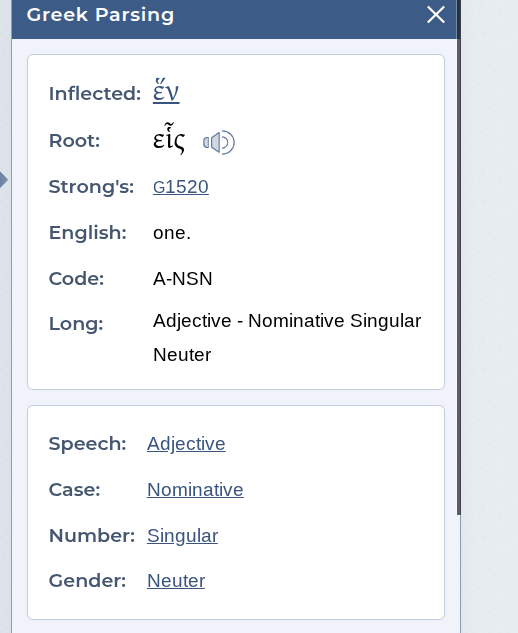
But in Greek, the word used is ἕν (hen) — neuter, not masculine.
A masculine form would mean:
One person
(But Jesus did NOT use masculine)
A neuter form means:
One thing
One essence One nature One being
He’s not saying:
We are one person
He’s saying:
We are one in what we are — God.
How do we know this is about divine nature/power?
Because of what Jesus said right before the statement:
“I give them eternal life, and they shall never perish, and no man is able to pluck them out of my hand.” (v. 28)
Only God gives eternal life. Only God’s hand is unbreakable. Only God preserves souls eternally.
Jesus claims He does this — and then says:
I and the Father are one.
Meaning:
The power behind the Father’s hand
Is the same power behind Christ’s hand
One nature → one power → one God.
The reaction of the Jews proves the meaning
If Jesus was only saying:
“God and I agree” “Me and God get along”
No one would pick up stones. No one was killed for agreement.
But what happened?
They grabbed stones to kill Him (v.31)
Why?
Because they understood He was claiming equality with God, not unity of opinion.
If they misunderstood, Jesus could have corrected them. Instead, He continued His claim with even stronger language.
Meaning their interpretation was correct.
“I CAME FORTH FROM the Father”
Joh 16:28
28 I came forth from the Father, and am come into the world: again, I leave the world, and go to the Father.
The Greek word used here is ek — meaning out of / from within.
This is different from the word used earlier in John 16:27 (para = “from beside”).
Joh 16:27
27 For the Father himself loveth you, because ye have loved me, and have believed that I came out from God.
Phrase
Greek Meaning
para
sent from beside / commissioned (mission)
ek
came forth out of / from within (origin)
So Jesus isn’t just saying:
“The Father sent Me.”
He’s saying:
I originate from the Father — from within His own being.
This includes Eternal Sonship, not just earthly mission.
Not created. Not formed later. Not a prophet who began in Bethlehem.
Before the world — He already existed with the Father.
“and AM COME into the world”
This refers to the Incarnation.
He didn’t begin when He entered the world — He came into a world He already existed before.
This implies:
He existed prior to birth He entered humanity willingly He is not earthly in origin
“Again, I leave the world”
You can’t return somewhere you never existed before.
To leave earth and go somewhere else means:
His life didn’t start here
His existence continues after death
His origin is heavenly, not human
This is pre-existence in plain sight.
“and go TO the Father.”
He returns to the place He came from.
Not created but returning. Not elevated but restored to glory He already had.
John 17:5 makes the same point:
“Glorify Me with the glory I had WITH You BEFORE the world was.”
John 8:42 Jesus Claims Origin OUT OF God, Not Just From God
If God were your Father, ye would love me: for I proceeded forth (ek) and came from God.”
Most people read that fast and miss the key clause.
Jesus doesn’t simply say:
“God sent Me.”
He says:
I came forth ek God.
The Greek word ek (ἐκ) means out of / from within — not just “sent by.”
This means:
He didn’t begin to exist at Bethlehem He originates from within God’s own being His nature is the Father’s nature — divine essence
No prophet ever said that. Angels never claimed that. Only someone who shares God’s essence could.
Two claims in one sentence:
Phrase
Meaning
proceeded forth (ἐξῆλθον)
I come out from God — origin
came from God
I am present among you because God sent Me — mission
These are not the same idea.
Most people read it like one statement, but it is two different truths back-to-back:
He comes out of God (origin in God’s essence)
He is sent from God (mission into the world)
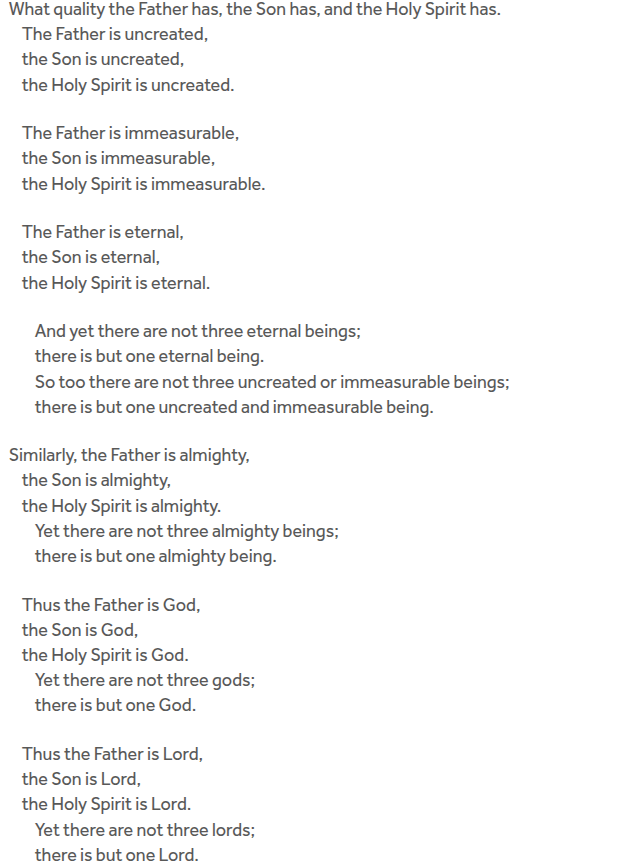
Historical Support — The Athanasian Creed
Before we close Part One, we need to show something important:
This understanding of one God in essence, three Persons in identity is not new. It didn’t start in the Middle Ages. It didn’t begin in councils. It didn’t evolve over time.
The early church already believed this — right after the apostles.
And the strongest historical witness that summarizes what Christians held is:
we worship one God in Trinity, and Trinity in Unity; neither blending the Persons, nor dividing the essence.”
The Father is God, the Son is God, the Holy Spirit is God — and yet not three Gods, but one God.”
This is the same truth we proved with Scripture: one essence, three Persons, one God.
God is one because His nature is one. Three Persons share that one divine essence without division, change, or hierarchy. The Father fully possesses it. The Son fully possesses it. The Spirit fully possesses it. And because essence is what makes God God — you have one God.
Understanding part 1 is crucial to understand the rest of this series in part 2 we will show the pre-existence of Christ in the Bible
Related
By Eleazar
Given sense of the bible from A to Z through the power of the holy spirit.



 The Bible Vault